5. Why does episodic rainfall lead to both flooding and drought in degraded catchments such the Almanzora river?
- Organically Written by a human without AI generation
My understanding of the causes of episodic heavy flooding followed by droughts and the effects of them in this area tends towards several interacting conditions, which have progressively intensified the outcomes because of the causal loop, which is deteriorating because of human interaction with the landscape over time. We get heavy rains, landing on dry impermeable surfaces, followed by dropping water tables as water cannot be stored meaning drought for the Mediterranean dry & hot portion of the year.
Rainfall intensity and runoff coefficient
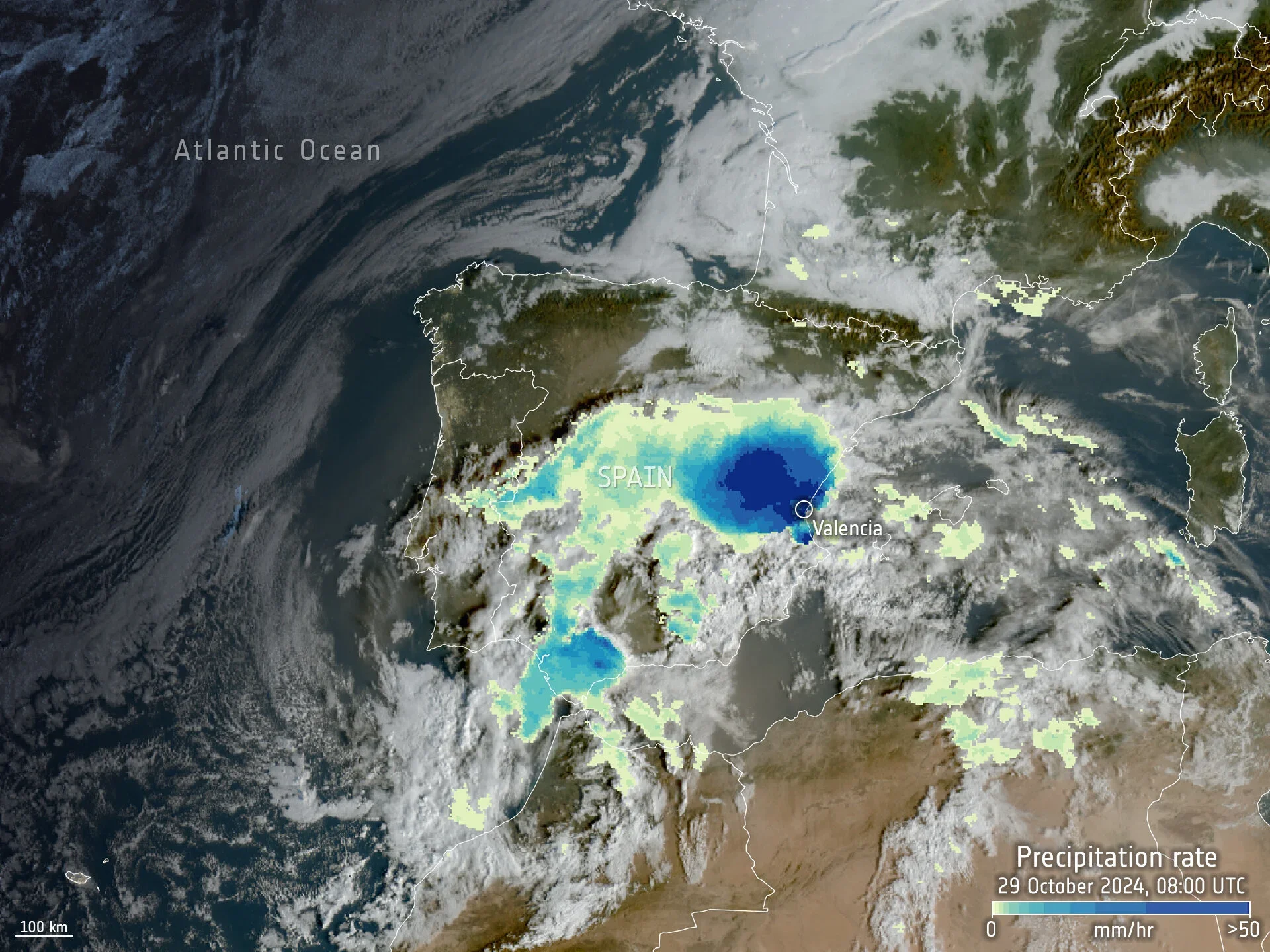
Evidence shows that the geomorphology exposed as it has been influenced by the heavy bouts of episodic rainfall which are so well known and characterise the area, have a popular name - Gota Fria, but more often in technical writing it’s known as DANA (Depresión Aislada en Niveles Altos). The phenomenon is infamous for the flashy nature which at first is a much welcomed drink for the parched plant life but then can become dangerous by its sudden nature, unleashing heavy floods as the large amounts of water hit desiccated, hydrophobic land with little to no soil on much of the elevated watersheds such as the barren looking hills that bracket the valleys. Alarmingly the occurrence is becoming more intense year on year as discussed in this recent paper: Human-induced climate change amplification on storm dynamics in Valencia’s 2024 catastrophic flash flood.
The brown flows of water carry topsoil, accumulated pollution, and debris down rapidly, ripping more up if it gets in their way and scouring the surface of the eroded gulleys made in previous showers, heavily erosive and the main contributor the shape and ground conditions of the ramblas. Without vegetation in the pathways cut into the earth, these floodwaters gain a lot of speed enough to carry away built structures and roads at time, and as we see yearly - they can sadly take human life too. The cycle is in a loop meaning the ramblas and the water pathways to them have become sealed surfaces, great for travelling over when they are dry, some can be used as roads you can drive on directly during the summer, but this is the exact reason they are lethal when it comes to allowing flash floods traverse along them in its carved out path towards whatever is downstream. The earth here is baked during the dry part of the year and compacted, so when the water does eventually fall, it’s like hitting a road surface which can’t absorb any of it. A lose-lose situation.
Infiltration, soil structure, and storage
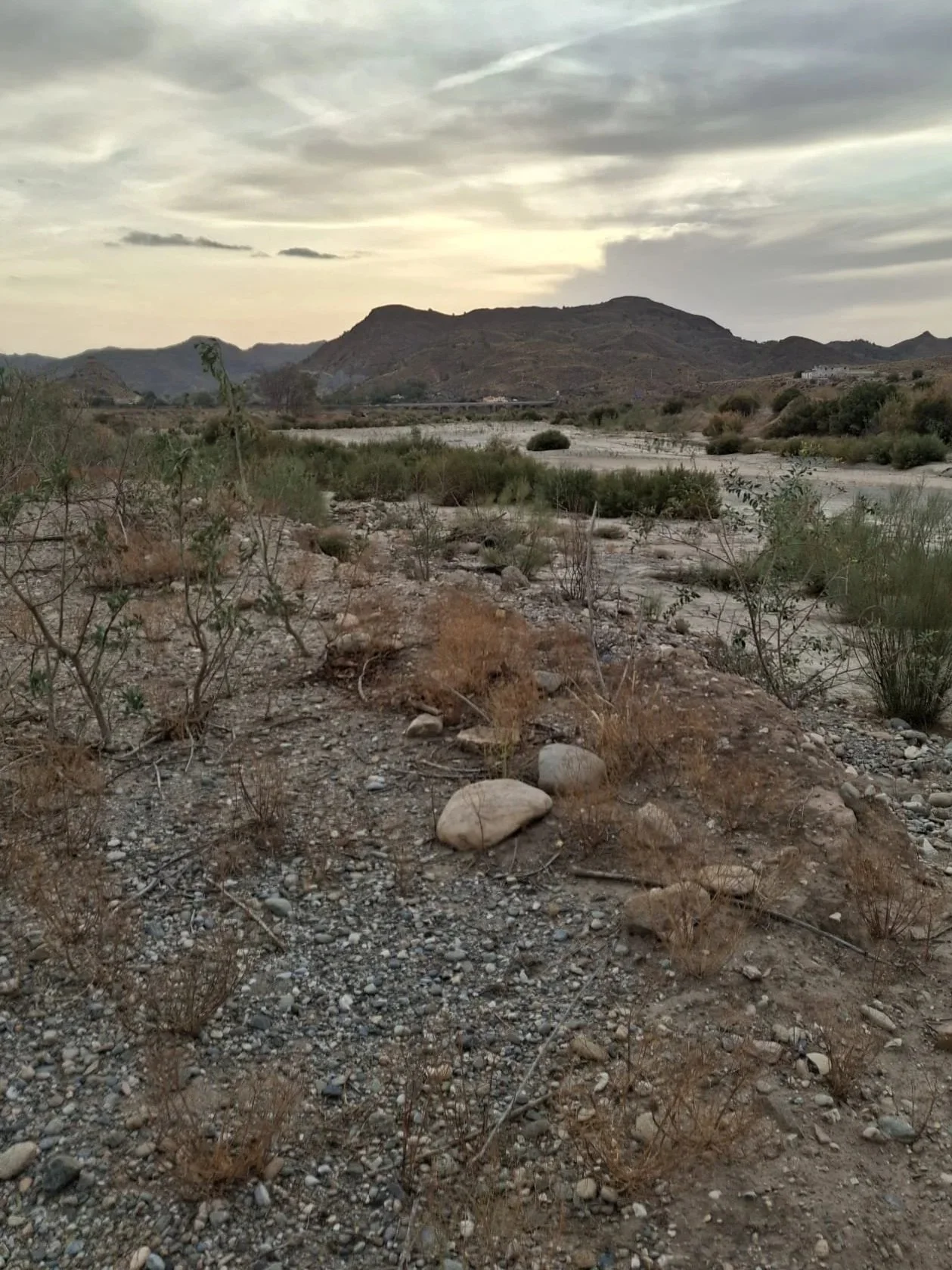
What the water lands on is next. Unless there is intervention somewhere along the temporary watercourse, the heavy pulse of water can rip out vegetation that managed to grow there in between this and the previous floods. Meaning any progress made for the land to repair itself is frustratingly lost. Soils that had accumulated around the temporary vegetation or shade provided by older debris is also washed away, starting the game again. Pollution from human settlements, litter and agricultural runoff is also washed down the same route, so it’s not exactly water you would want to bathe in, play with, or irrigate your food with. (For that to happen you would need a few intermediate steps in between and to cut these unwanted inputs further upstream). Because of the low amount of organic matter on the surface, making the ground mostly consist of either sand, stone and rocks on the hill sides and some parts of the flatter valley bottoms, and hardpan baked clay surfaces in the ramblas, there is little holding capacity all round. There isn’t a lot of space for water to infiltrate and be held for long periods of time in the baked clay area, and the sandy rocky areas let it go too quickly for plants to consume for extended periods of time.
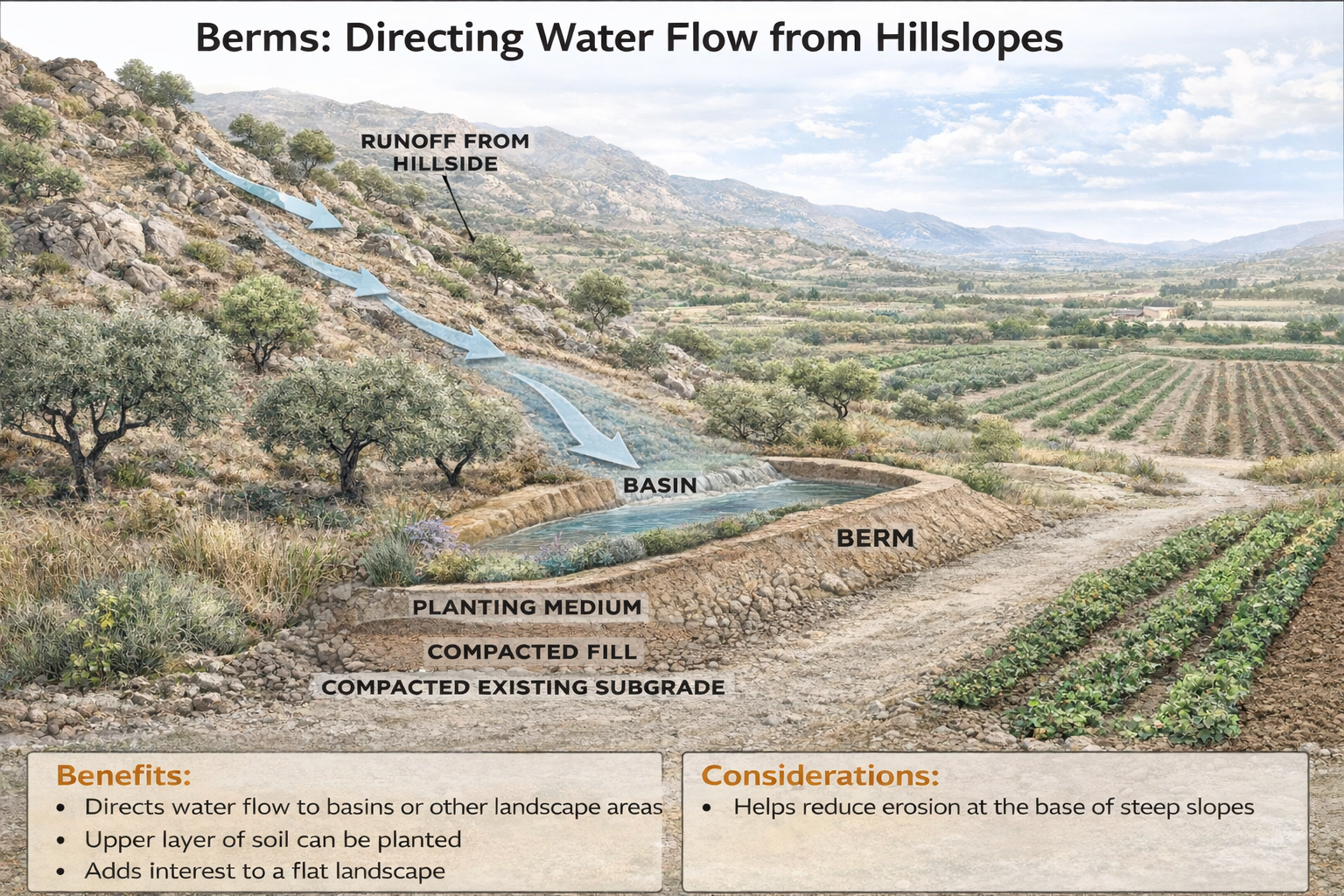
An illustration inspired by Rainwater Harvesting for drylands and beyond, Authored by Brad Lancaster - depicting what i am proposing to do as an intervention measure where possible, reducing flash flood volumes and holding and sinking water longer, allowing the landscape to act as a slow-release sponge.
Connectivity, baseflow, groundwater
Unfortunately left to its own devices with us living how we do upon it, the water cycle is in decline and can’t reboot itself, not for lack of trying. Any soil material that does manage to get caught up and stick around will benefit from the moisture and then has the yearly warm period of drought to make it till the next rains in some instances. if we are lucky some of the hardier pioneer species of plants can eke out an existence and take a hold here, building tiny islands of life in the great dry expanses of hardened earth you see from your car when driving by or over the Ramblas. The ephemeral nature of the pulses of water means that in its current state the reach can’t re-establish a connected baseflow where water infiltration from above joins into the groundwater as a connected body of water. (see paper: Numerical simulation of water infiltration into soil and investigation of slope stability using the effect of different rainfall intensities). It also doesn’t have a chance to backfill up to the sides of the valley to the feet of the hills either side and build out deeply connected a flood plain that can hold the water in the soils as a sponge until the next instance of precipitation.
Conclusion
Hydrologically for this area, we are at the bottom of the water cycle, the hydrological process our lives depend on is on life support and needs a hand in getting back onto its feet to improve. as years go by the water with the aid of gravity, scours the ramblas yearly and cuts ravines and gullies into the hills. the dark pronounced lines you see on the hills would not be visible in latitudes further north where there is enough rainfall spread out through the year to make it easier for the plants to cover them, and the plants in turn would prevent them from being so deeply cut into the hillsides, building soil rather than stripping it and ultimately preventing the harsh drought conditions we experience here. Tough drought conditions aren’t just the lack of rainfall and heat from the sun. even the harshest deserts have healthy, beautiful oasis settlements where hydrology allows.
Without a layer of soil able to build itself and restart the regenerative processes it has the potential for, the land can’t function as a sponge saving the water in the ground itself, slowly releasing it throughout the year, and mitigating heavy flash flooding, especially for those downstream. It can’t slow the water down, capture the particulates floating in it returning fertility to the ground and releasing clear water we find in other regions of the country.