6. What are the dominant feedback loops driving hydrological degradation in semi-arid landscapes?
- Organically Written by a human without AI generation
Here I attempt to break down the key feedback loops driving the evident hydrological degradation of the Semi-Arid environment of the Almanzora river. I discuss land use – the initial break of the cycle, reduction in vegetation and the somewhat controversial biotic pump, and finally the resultant altered albedo, and how it is its own loop as well as part of another above it.
The effects of Human land uses, especially impacts from intensive farming practices.
Deforestation > Erosion > reduced infiltration > further loss of vegetation > Erosion > reduced infiltration…
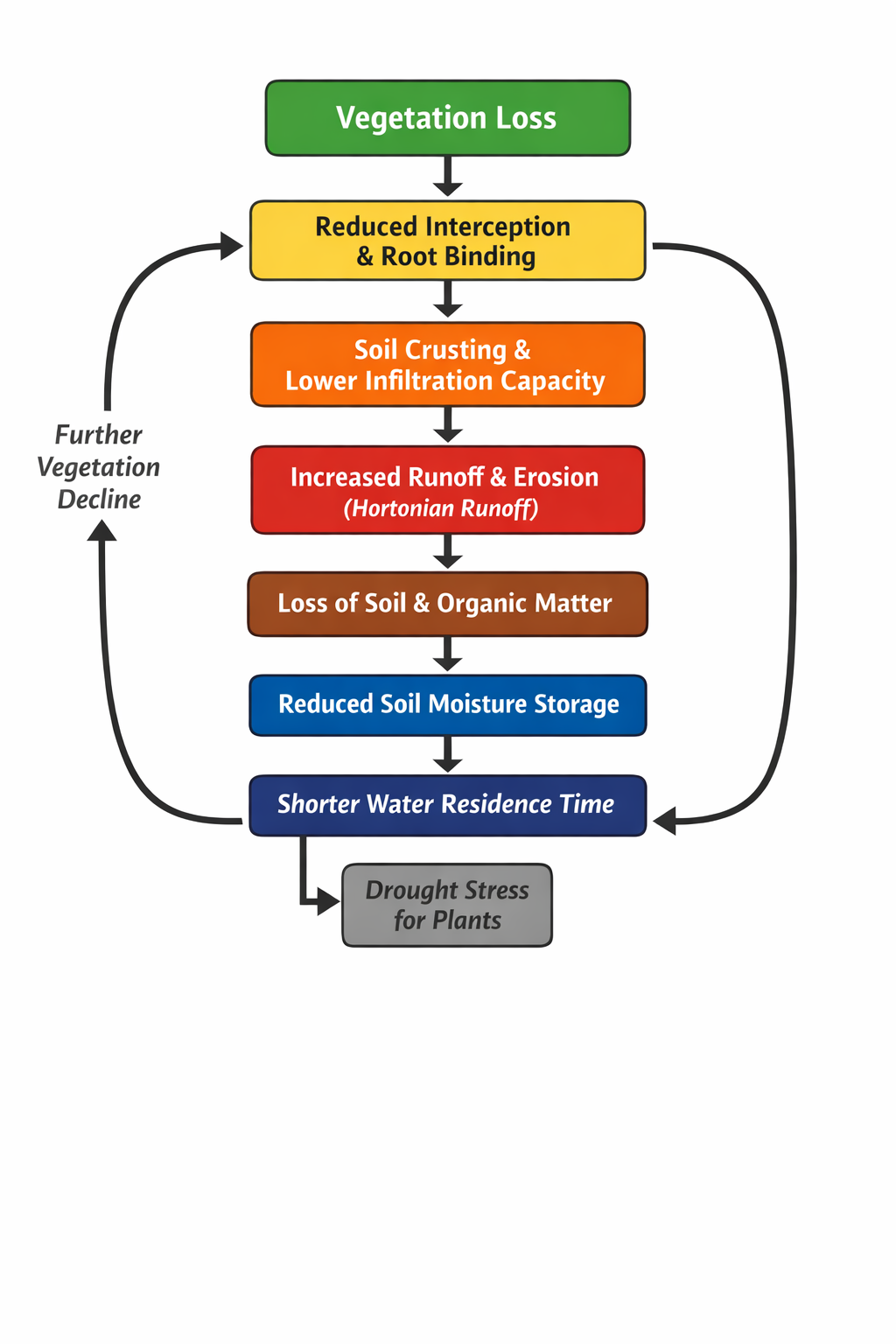
The impact of historic land use in the Mediterranean has been debated widely, summarised well in the paper by Karl W. Butzer - Environmental history in the Mediterranean world: cross-disciplinary investigation of cause-and-effect for degradation and soil erosion (doi:10.1016/j.jas.2005.06.001) – where it shows there have been studies going on since the 60’s about whether the land use over the last 8000 years has degraded the land. The consensus is that the primordial forest that one covered the Iberian Peninsula is largely gone, predominantly from human activity, although anomalous meteorological events cause devastation regardless of whether people are there or not. These are the exception though and not the norm. Land deforested and used for pasture with cattle, although it looks green and healthy with grass cover, the animals stop anything substantial growing back which can create the feedback loop here of:
Human activity for sustenance and survival has depended on clearing forested land, using wood for construction and fuel, and farming the cleared land for crops and pasture of animals. This is the first step in this loop of degradation; the next step is the same weather and precipitation to hit the area is now received differently. Rain that was intercepted by the tree canopy thereby reducing its built-up kinetic energy- By allowing water to run down branches and trunks to the base of the tree or drip from the leaves gradually in the trees drip zone. The Rainfall now hits the ground with its terminal velocity gained falling from the clouds, before impacting the soil and rocks, which in turn take more kinetic energy causing splash erosion & surface crusting (see this article - Soil Crusting) it doesn’t have the same time to soak into the ground so runs downhill faster than before.
Repeated in every storm, or rain shower the impacts begin to snowball getting worse with each cycle, changing the capability of the land to absorb each storm. This itself over millennia is a cyclical process degrading and aggrading over time with periods of intensification and collapses where nature gets a chance to regenerate, but its overall a declining trend looking over the anthropogenic (Human) timescale.
The Aeolian effects (Wind erosion) also become a bigger issue when deforestation has occurred. Wind once stifled by vegetation, capturing dust particles, are now able to scour the ground unabated, picking up and hurling the dust at the next hills and rocks in its path, which as well as causing more erosion, also greatly increases the soil evaporation rates in the area. (See Forest evapotranspiration trends and their driving factors under climate change - ScienceDirect for a deeper explanation of the possible influence caused by deforestation to evapotranspiration trends). This is part of a loop of further drying out of the ground. This in turn leads to lower Evapotranspiration in this case, meaning lower humidity, and less local rainfall contributions. Simplified this loop is:
Vegetation loss > lower transpiration > lower atmospheric humidity > less local rainfall recycling
The impact of reduction in Land-Atmospheric Coupling (Biotic pump activity) due to deforestation and degradation.
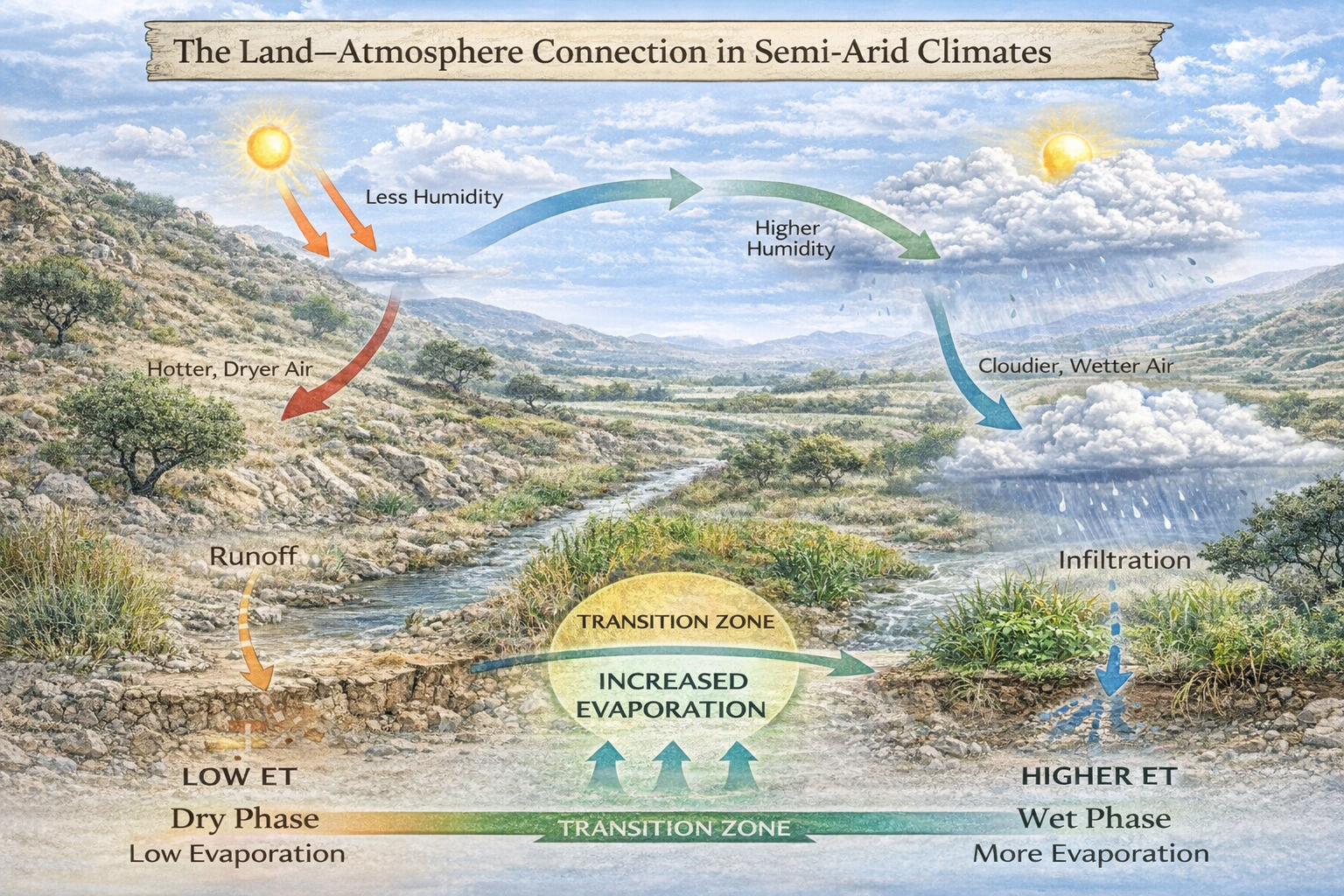
Land atmospheric coupling is a theory held on the connection between Land and atmosphere processes which influence atmospheric moisture, the energy balance and precipitation. Its generally a more accepted framework than the ‘Biotic pump’ idea originally put forward by Anastassia Makarieva and Victor Gorshkov, and analysed in the paper Winds and rain: the role of the biotic pump Volume 6 Issue 5 - 2020 Peter Bunyard Independent research which in a nutshell proposes that forests contribute to local rainfall via high rates of evapotranspiration and also generate the winds that carry them. The Land Atmosphere coupling model is more modest in its claims, but the underlying processes are very similar, in terms of precipitation > interception by vegetation > infiltration into soils, evapotranspiration back into the atmosphere > precipitation further inland. Logically it follows that if we remove the inland ability to keep cascading water further inland then the interior landmasses will eventually all be affected with reduced rainfall further exacerbating the issue. Lower soil moisture leads to less evapotranspiration, meaning lower humidity in the low atmosphere close to the ground, leaving the energy potential of the moisture in the system tending towards even higher E.t rates. These loops are far more consequent in tropical forests than Mediterranean ones, there is still a measurable weakened land-atmosphere moisture feedback loop.
Ground Erosion
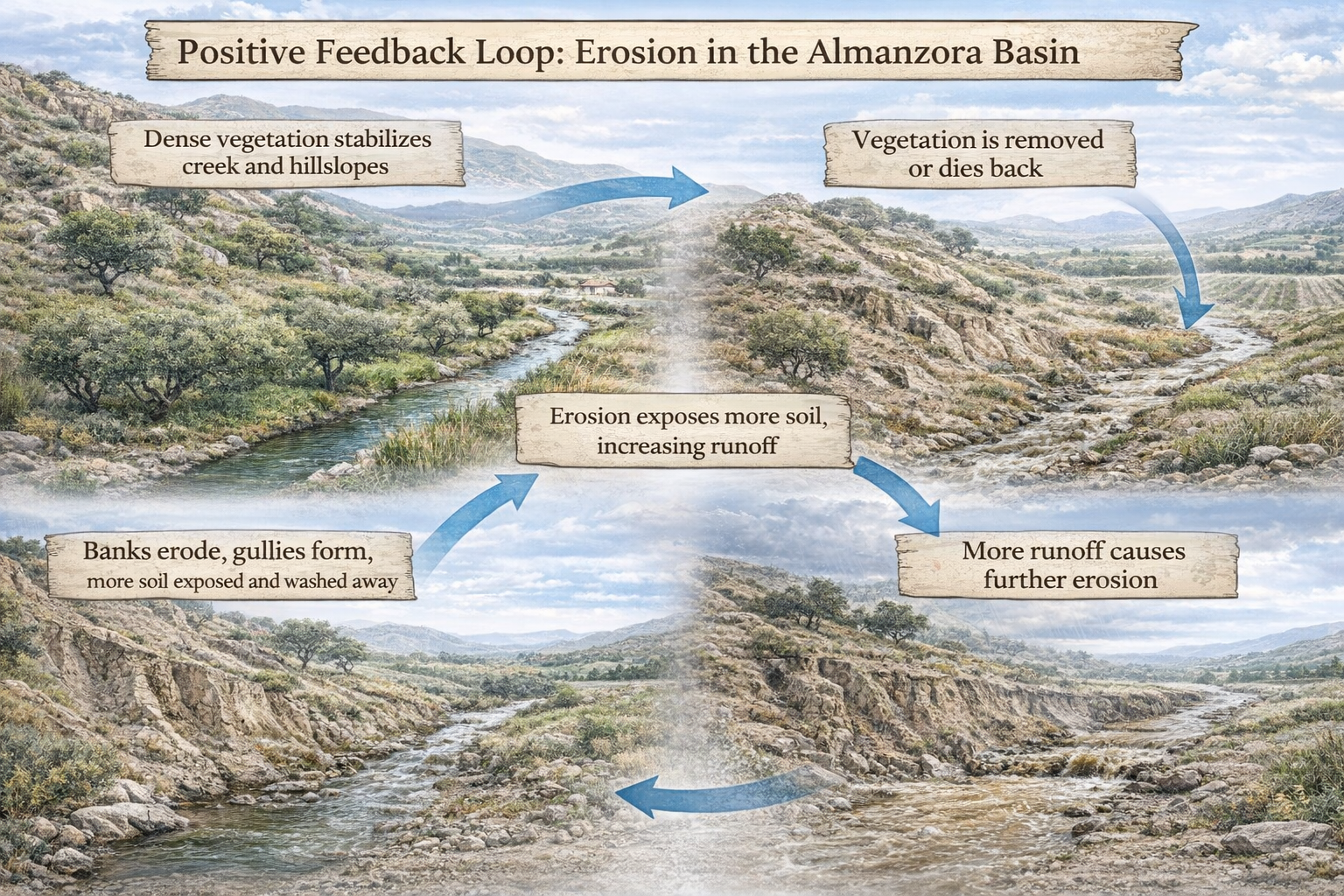
As mentioned earlier ground erosion is another negative feedback loop affected in the area, as the planet warms and we reach/pass climate tipping points the climate swings become more extreme. Extreme weather events have been steadily increasing in severity and quantity (parasol-lost.pdf - Parasol Lost: Recovery plan needed Global risk management for human prosperity). From the flash floods filling newsfeeds numerous times yearly now we see that the water is almost always full of carried sediment. The amount of damage to the landscape is unmeasurable but it leaves a trail of deposited alluvium which infrastructure has evolved to divert away from developed areas as quickly as possible. This scours the land making for deep cut drainage gullies in the land, which stop the next floods to flow down them from soaking into the ground. This lack of infiltration further dries the watershed out and makes the land more susceptible to damage in the next instance. Once in this state its very hard and takes some incredible amounts of damage to rectify itself naturally so will continue to erode the landscape. Here the loop is:
Soil eroded > decreased vegetation to slow water > Flash flooding > heavy erosion > reduced moisture retention & carbon sequestration > Flash flooding > More soil erosion .....
Conclusion:
The Feedback loops above are all reinforcing (Negative) feedback loops in an interconnected, complexed system. If left alone they will continue in the degrading fashion towards greater aridity, more damage to built natural infrastructure harder to come back from in what seems like a dwindling amount of time to do something about it.