7. How does soil structure influence infiltration rates, and what processes lead to its collapse in dryland systems?
- Organically Written by a human without AI generation
While composition and amount of water received in storms are notionally understood as deciding factors of infiltration rates in soils in a given area, the structure of soils themselves is more important in terms of how much water sticks around to be infiltrated into the layers below the surface, and what makes it down to the aquifer level. Soil structures also play a huge part in what constitutes a healthy landscape, and what processes lead to a degrading soil layer overall. Here I will discuss how composition, past the high level & simplistic terms of the soil triangle(Soil Texture), such as Aggregation, Litter crusts & amount of SOM (soil organic matter), as well as the layers of the soil horizons and their depths all paint a picture of what is happening. showing the difference in the soil layers in examples of healthy dryland ecosystems and degrading ones which tend towards desertification.
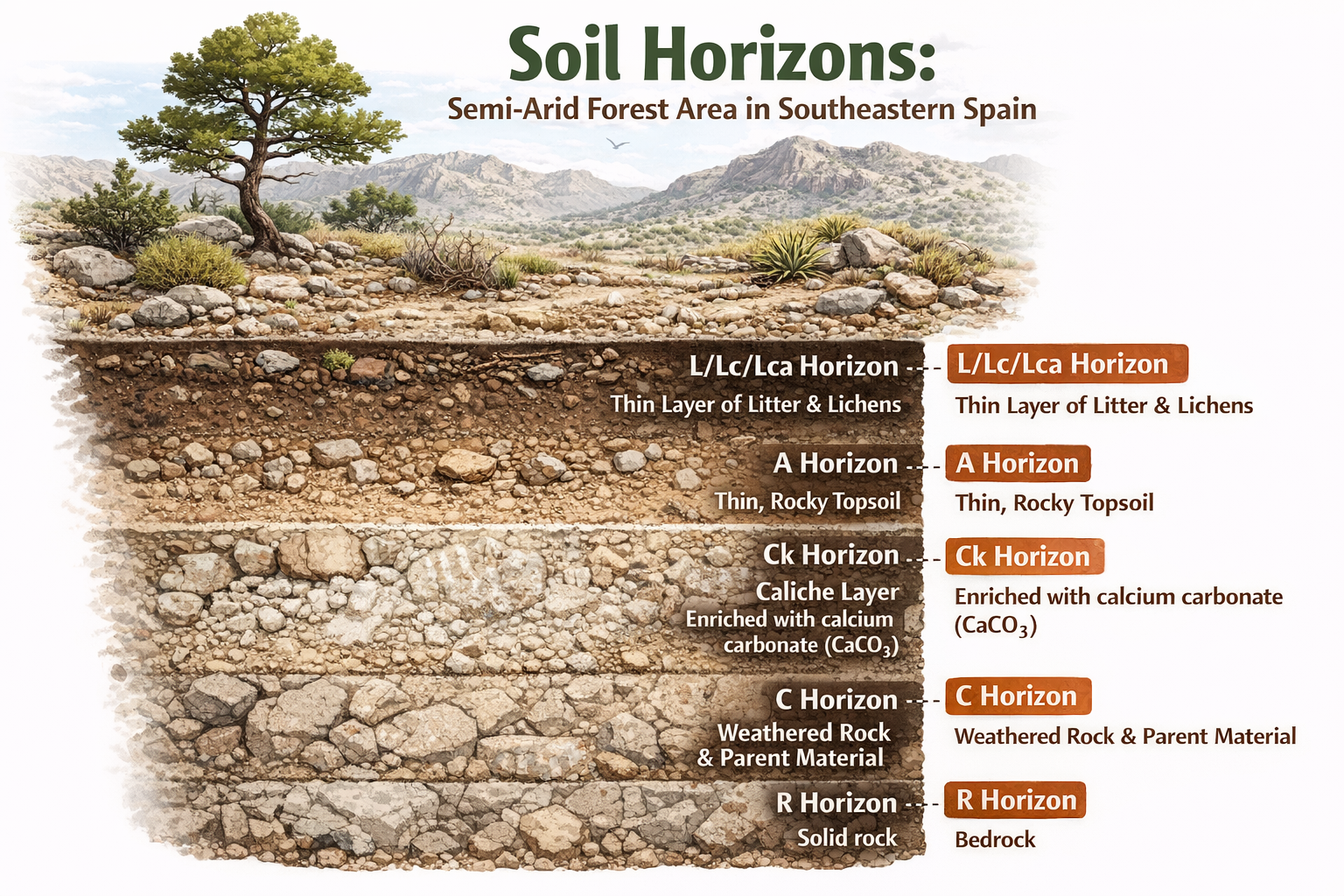
A generated image depicting Soil horizons in a healthy dryland forested area.
First, how structure and texture affect infiltration…
Composition, Texture & Structure beyond the ‘Soil triangle’ and what it means for infiltration rates.
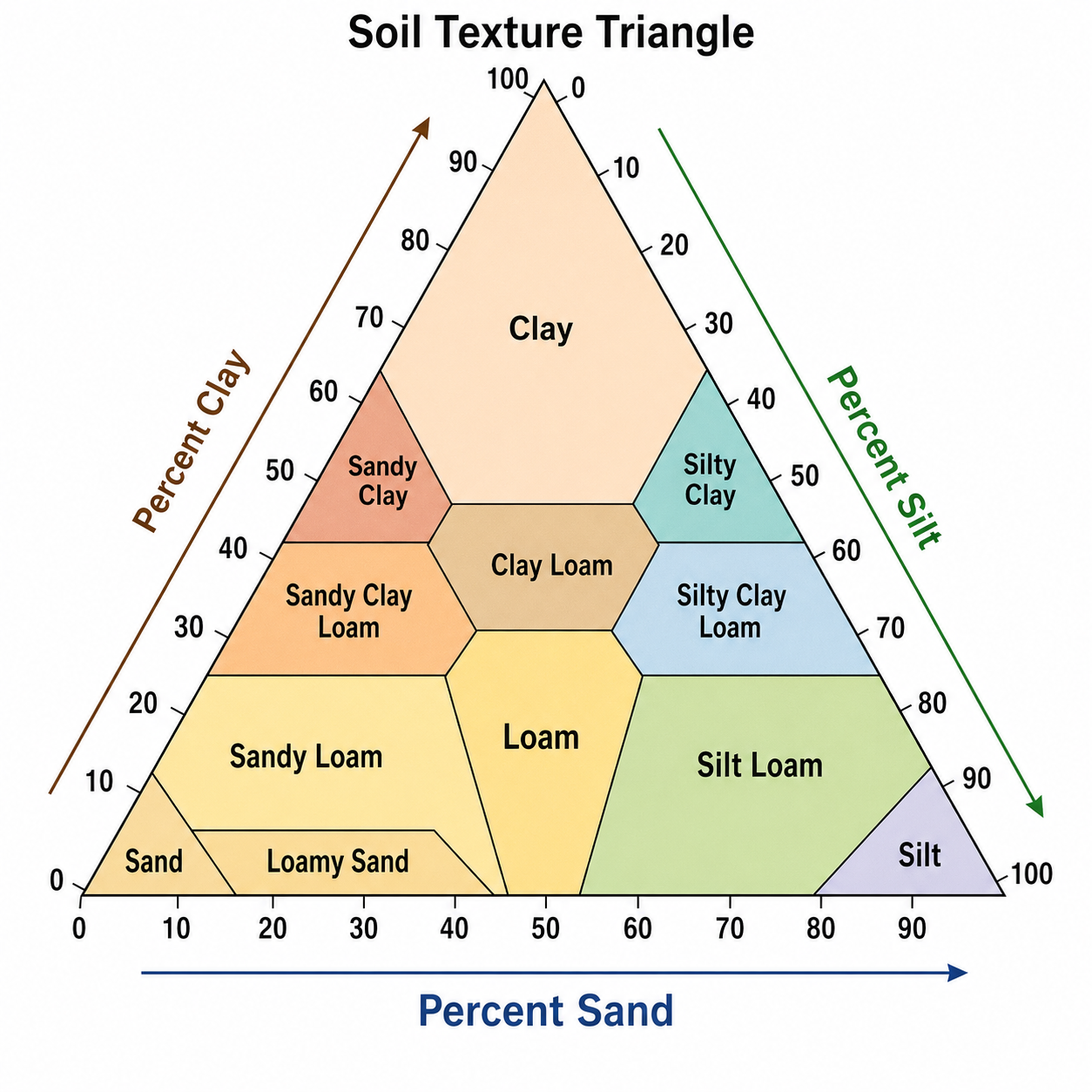
The Soil Triangle - (a way of classifying Soil Texture)
To begin with, soil texture is where soil is classified by its content which can be categorised using the triangle graphical representation which gives you a rule of thumb of what type of soil you have. You can deduce what soil type you have by a number of methods, the simplest would be to roll a “sausage” of the soil in your hand and feeling its consistency, and visually looking at what kind of form it can hold. The next in order of complexity would be a deposition of the sample by mixing the sample into a container of water and letting gravity sort the particles into striated layers, then measuring the volume of the sample into percentages roughly to compare with the soil triangle, there are other more accurate ways of determining it after but the end result is similar. From this you can deduce the amount of sand - high infiltration, and the amount of clay content - high water holding capacity, and silt giving workability. These insights are good for high level indications but don't give a detailed insight as to what makes the structure of the soil and gives it the qualities/weaknesses affecting the site.
Additional Factors….
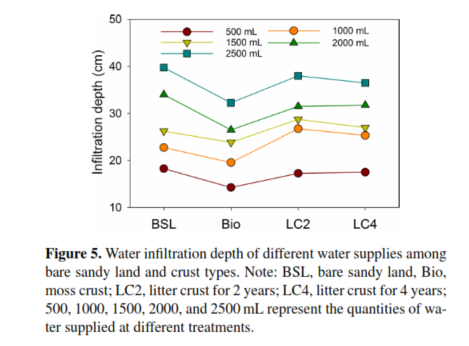
Graph illustrating these influences on soil moisture infiltration from the study, “The influence of litter crusts on soil properties and hydrological processes in a sandy ecosystem”
Soil organic matter measured as a percentage has an impact on how much water is infiltrated into the ground and held for extended periods. It can hold up to 3400 gallons per acre for each 1 percent of soil organic matter on top of the usual capacity, this also prevents rapid evaporation (Organic Matter Can Improve Your Soil's Water Holding Capacity).
Soil compaction, is a process driven structural characteristic which determines water infiltration rates of highly compacted soil - creating a less permeable layer by squeezing air gaps out meaning water has less gaps to fill. This can be caused by high foot traffic or machinery compacting the soil. Agricultural practices that avoid heavy traffic on the soils are implemented to reduce this effect. Also similarly is Soil porosity is a structural characteristic determined by particle size, organic content and how the soil is aggregated together.
Existing levels of soil moisture also affects how much water can infiltrate. If the soil is completely dry, it becomes hydrophobic until immersed again for a period of time and so initially will cause runoff in the first shower of rain until it begins a high rate of absorption, slowing down on the curve as the measured field reaches its field capacity.
The soil horizons. (OAEBC) and what they mean in relation to infiltration?
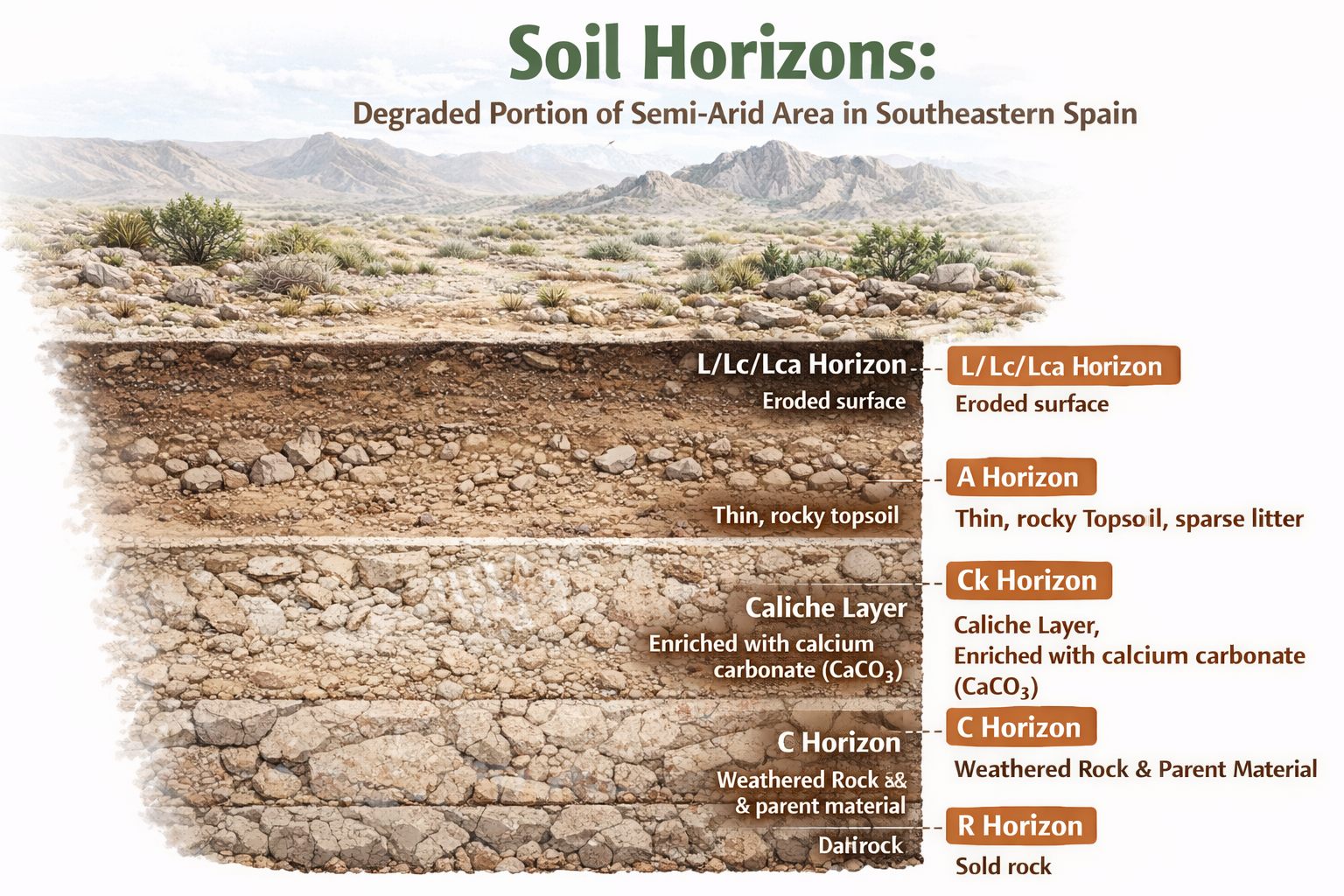
Degraded Dryland Soil horizons
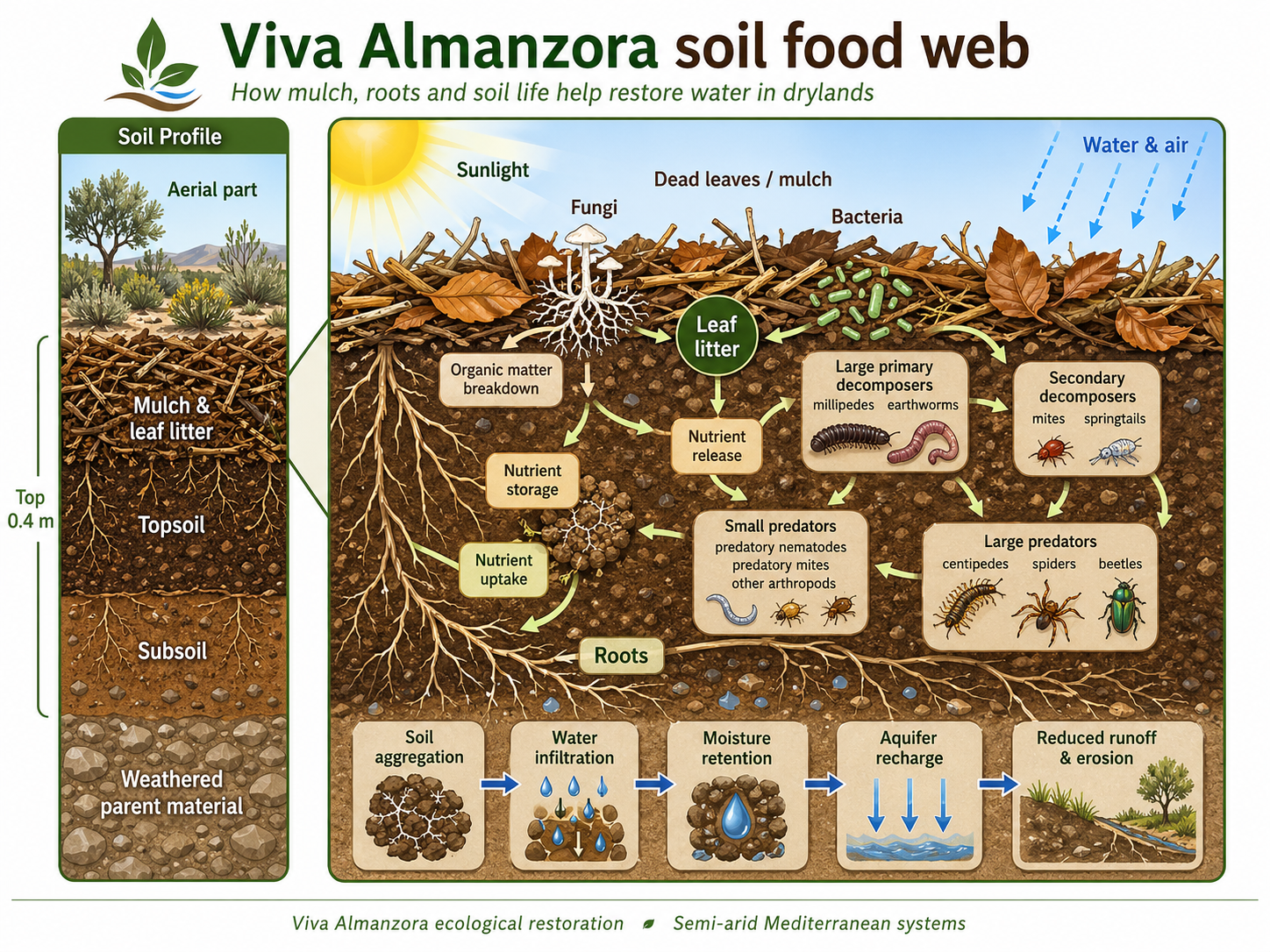
The soil horizons view of how soil structure occurs, is a way of describing the different levels of how soils develop from the surface working down to the bedrock. The top layer being O (Organic layer) made of hummus, consists of all of the organic matter such as leaf litter, broken down plant matter etc. this layer is vital for breaking down into the layers below, providing nutrients from the matter itself as well as from the biological activity taking place from microbes and fungi, which disappears into the A Horizon below - the topsoil layer. The topsoil layer is richer in minerals mixed in with the hummus and is the optimally placed region for plants' fine roots to spread and absorb nutrients and water. Helped by microbial life, here is what makes the sponge we rely on to absorb the pulses of water received in rain showers. The higher the amount of organic matter or SOM (Soil Organic Matter) the higher the FC (field capacity) which can then hold the water in it for extended periods of time. The key factor here is time spent in the zone between field capacity and the lower end of the window being the permanent wilting point that is the sweet spot for both plants, and for slow enough infiltration of water into the groundwater aquifers below. Too much water above field capacity means surface runoff which then becomes erosive, too little moisture, and the biological activity slows down and soils at the surface become desiccated and are blown away by the wind.
In ideal conditions there are inches of enough of these top two soil horizons that water can be held and the soil production process can take place optimally, continually building fertile material.
Crusts ? Biological vs Litter crusts & Soil organic matter.
Soil crusts are also an integral part of the anatomy of the earth's surface, relative to the current conditions and weather patterns. Although they can be almost imperceptible from afar, crusts have a huge impact on the further building of the soils which they encase underneath. Bio crusts, commonly found in degraded semi arid areas, blend in with the surroundings made of algae, mosses and lichens. They form a thin layer from millimeters to centimeters thick which intercept the sporadic rains. They benefit from them attenuating the water's energy and absorbing as much as it needs before it evaporates. What it doesn't do is allow the water to get into the soil layer below and soak into the ground. Further soil production cannot take place so this becomes the status quo in these localised areas.
Infographic showing the often understated role Litter crusts play in ecosystems
Conversely litter crusts are formed from falling debris and leaf litter. This layer builds up over seasons where the weather dictates and intercept water too, except in this case the leaf litter crust provides far more benefits to the soil layer beneath.(see: The influence of litter crusts on soil properties and hydrological processes in a sandy ecosystem-Yu Liu).
Leaf Litter crusts hold a lot more water, shade the ground keeping soil cooler underneath by up to (15 degrees C) even in the desert conditions of almeria where it can reach 40 odd degrees ambient temperature. The leaf litter also breaks down into smaller particles beneath which rots into humus, becoming new soil.
It is within these crusts that work their way down that the fungal, bacterial and invertebrate life consume the material and excrete enzymes, further digesting it releasing the chemical compounds and building blocks used by plants in these ecosystems. Larger creatures like worms and burrowing insects create channels through the soils combining them into worm castings whilst also creating pathways for water and roots to infiltrate deeper into the earth below. The organic secretions from these creatures of all different sizes hold the soil particles together and water is held within them, locked in until it itself is extracted later on by plant life.
2nd - Processes which affect degradation, and what can influence soil aggradation
Climate change extreme events such as flooding etc
Processes such as extreme weather events, wilder swings in terms of intensity of storms, rainfall events, droughts, wildfires etc all contribute to instances where greater damage to the current layer of soil on the landscape can take place. A flash flood for example rips away far more precious top soil than the average runoff event, and due to human induced climate change these extremes are far more frequent. The EEA report found here: (What will the future bring when it comes to climate hazards? - Overview | Europe's changing climate hazards — an index-based interactive EEA report | European Environment Agency (EEA) demonstrates this is a growing trend. We are moving toward a new far more extreme climate. Europe is the fastest heating continent on the planet, showing no signs of slowing down.Each wildfire we experience burns more protective shielding against the elements, wind can scour the exposed surface and subsequent storms can remove even more soil.
Land use change
Due to loss of natural soil inputs from deforestation, farming and overgrazing where uncontrolled cattle are allowed to damage what vegetation is left means that we also slowly degrade the soils too. Even if land is transformed into green pastures covered in grasses and shrubs, the soil is no longer able to sustain itself perpetually and begins a slow death over decades in some instances until it cannot support even the grasses used to feed the animals. Without a consistent input of fallen material from natural ground cover it degrades over time.
The other form of land-use that affects soils is covering it with impenetrable surfaces such as concrete and tarmac. They stop all soil life altogether and therefore allow no infiltration of water. Instead diverting torrents of water to drainages that either cause more damage elsewhere, or just flow rapidly out towards the sea carrying pollution and valuable moisture with it. This results in next to zero valuable water infiltration.
Conclusion
In summary, the planet's reliance on the top 6 inches of its land mass is now widely documented and accepted although not a lot is done about it. The crusts and topsoil layer makes or breaks an ecosystem, anchoring moisture and infiltrating water into the deeper horizons of soil beneath the surface. The key processes of invertebrates ingesting and excreting soil particles, coupled with microbial life decomposing smaller materials which are all aggregated into what we know as healthy soils in every ecosystem determine how much water can be sequestered and used by plant life. Plants cannot survive or thrive without these components of the ecosystem supporting them and in turn the life in the soil cannot build and perform its roles without nitrogen and carbon being injected into the subterranean layer by the plants. By removing any of these components you take away one of the pillars holding up the system and it eventually crashes. As discussed above many external influences can interrupt the ecosystem and even if delayed the end result is barren landscapes.