9. Where Should Landscape Restoration Begin? Start With the Water
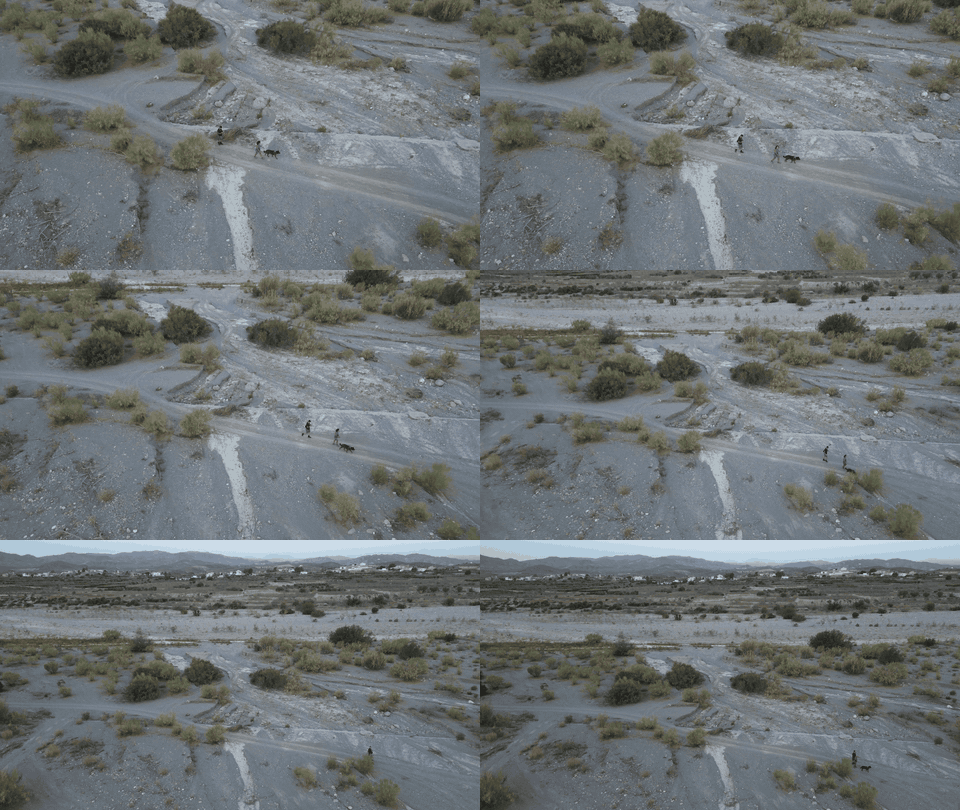
“The survey team” following the Rambla west of Los Navaros
Following an initial period of observations, analysing the layout of the land, focusing on the preparatory works before doing anything would be the best starting point to assess what hydrological functions are broken. Marking out the contours of the landscape, digging trial holes for soil samples and assessing the layers of sediment at different points, starting at the top of the watershed working down to the lowest points. Collecting this data and being able to build a picture, or better yet a model of the parcel of land which the design concepts can then be applied to.
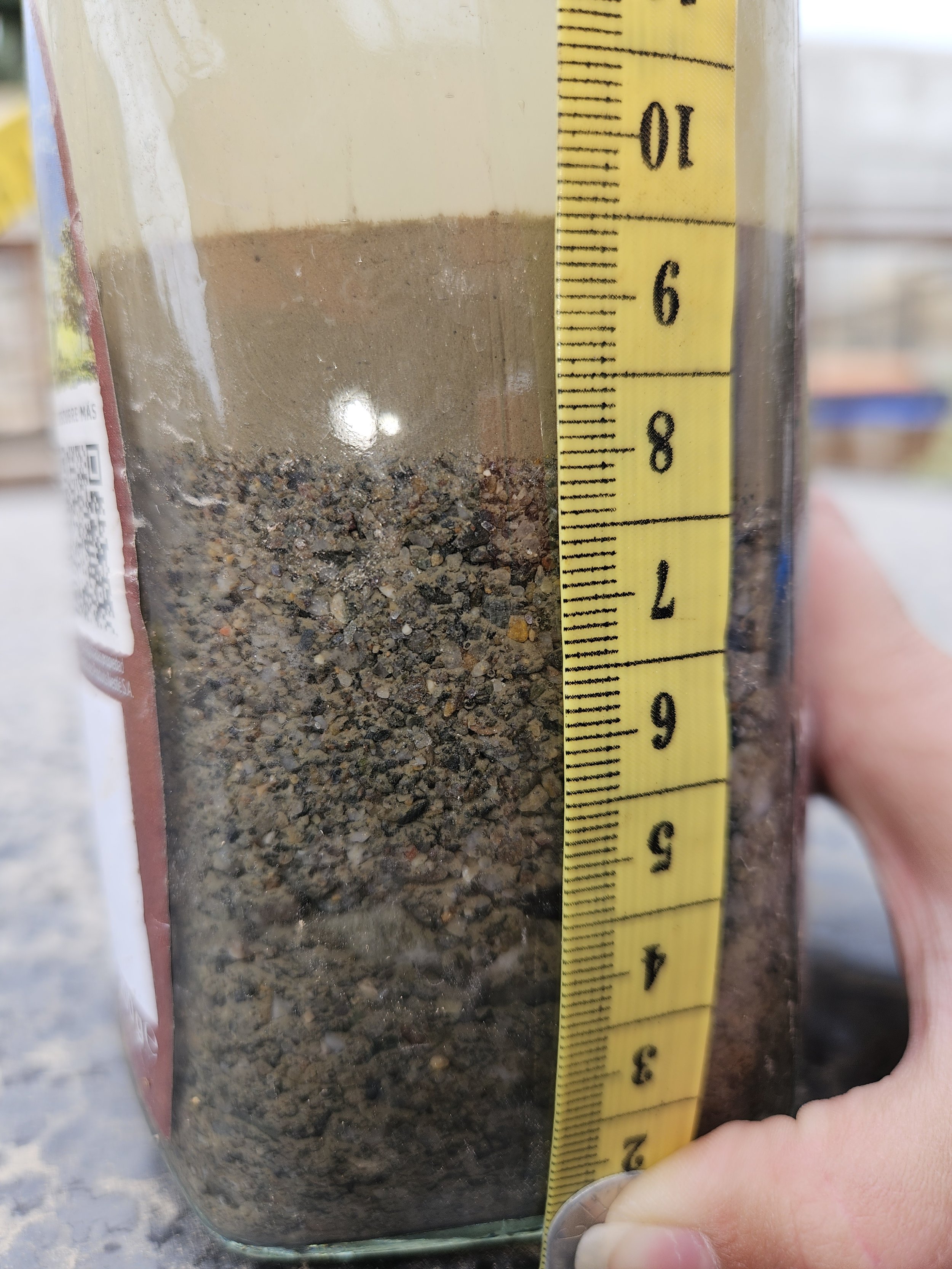
Rambla soil sample (Taken - 37°20'47.9"N 1°59'42.3"W)
With this first set of data to inform decisions and build on from now on, the first area to focus on should logically be the top of the watershed. The Hydrological function I would target therefore would be the slowing and spreading of received rainfall at the tops of the hills, covering as much surface area as possible. The highest elevations of the landscape you are working with will receive rain where we want to keep it for as long as you can, then allowed to trickle down slowly as possible. Ideally due to the limited nature of a water-controlled environment, directing the captured rainfall to concentrated areas to be used most efficiently would be the goal here, to reduce damaging soil erosion. Being at the highest point, it’s beneficial to start small by spreading the received rain out with small interventions such as one rock dams. This is to stop the water building up speed as it moves downhill, preventing the cutting into the hillside and removing material, keeping moisture up where pioneering plants can begin to grow (providing more resistance and infiltration higher up) – in the subsequent rainfall events that follow later.
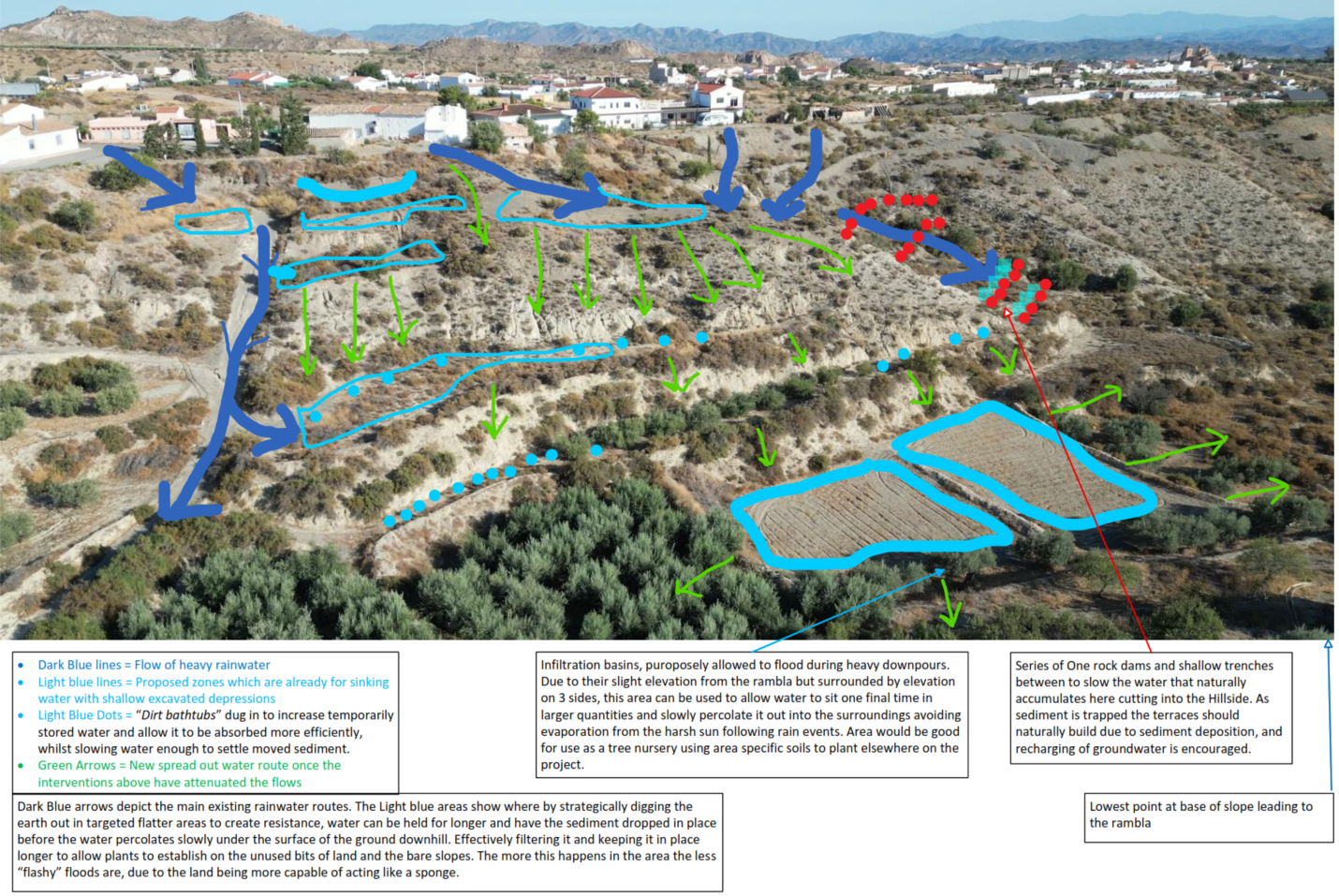
Snip from a rough design of a series of Earthworks interventions proposed for a potential pilot site at Sanat Marie de Nieve, Huercal-Overa.
Keeping the earthworks smaller at the higher points means that in the event of a failure - the damage will be minimal, and the water can be usefully managed on its way down via further earthworks. This is the benefit and underlying logic behind following this sequence of work for dryland hydrological remediation.
1. Small earthworks such as ‘One rock dams’, shallow berms, “Zunni Bowls” and swales as you move down from the summit of a hill to the lower ground, kick start the infiltration and sequestration which begin the positive feedback loop of:
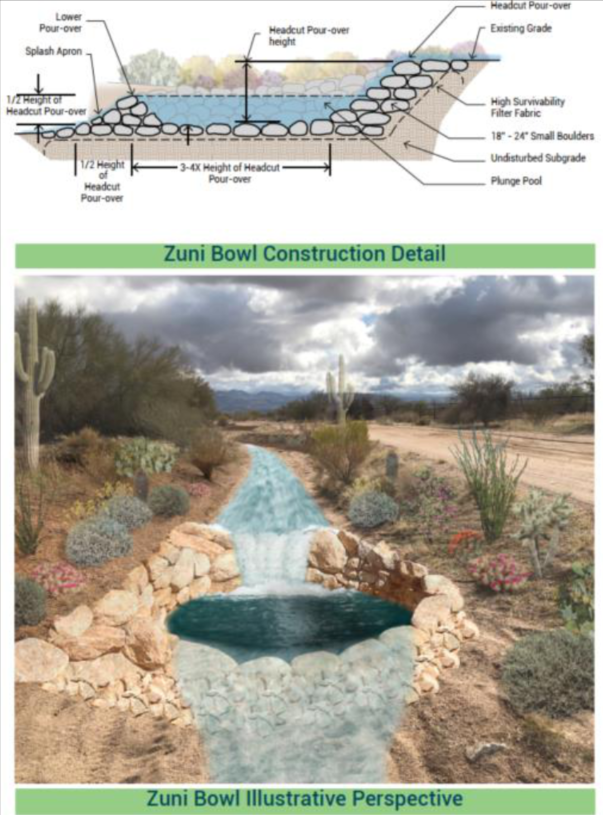
Image borrowed from: 20191202_Mohave_County_LID_Guide_Flood_Protection_Water_Sustainability
2. Small Interventions Enabling groundcover of pioneer plants to establish >
3. roots anchor loose earth and stabilise the hillside whilst allowing water to seep into the ground >
4. slowly the water cycle restores underground with water flowing downhill. Seeping slower under the surface >
5. More Pioneer plants can now establish further down from the 1 rock dams and recently established plant life, like a snowball effect further arresting the flow of water over the surface and infiltrating it more into the ground.
6. Back to point 3 in a loop.
Those are the benefits and the underlying logic in following this sequence of work to remediate dry land. Deviation from this order of interventions by working from the ground up, opens the project up for things to go wrong in a bigger way.
E.g. by building larger earthworks higher up, all in one go (rather than observing, acting, observing acting), you could end up with water hitting the watershed, making its way down at speed to the first earthwork and overwhelming the structure you have built. With nothing up higher to continuously absorb the energy from the flowing water, its force will likely be destructive, far more erosive and carrying valuable stabilising rock and topsoil away from where it's needed. Storing larger volumes of water at altitude is unwise without specialised engineered solutions, (which by their nature are usually more complexed and expensive to build).
Another factor to consider is how much impact you are having year on year with the placement of the structures. If in a hypothetical scenario you are limited to 1 weeks’ worth of work time available with a small team and a digger hired for 5 days using local material to build, and you could choose between a series of check dams on the Rambla slowing the water when it is running down following heavy rains vs building 1 rock dams up on the hillside adjacent to the rambla – the rambla check dams although effective, will be placed to slow water down and encourage deposition of silt, building and spreading in that localised area and will likely suffer enough damage to require rebuilding before the next Autumn/winter. The hillslope 1 rock dams will be subjected to less volume of water per rain shower and can spread more of it over a wider surface area allowing it to sink into the ground before picking up speed and eroding more of the hillside. This slowing and spreading action higher up in the catchment will lower the amounts reaching the rambla at first in the short term- but allow it to drip down over an extended period and over a greater area. This will encourage more pioneer plant growth to be sustained by the sub-surface moisture which then begins that positive feedback loop higher up – which can then be built on year on year. Less valuable topsoil is washed down into the rambla as well, creating islands of fertility which can gradually spread down. This option reduces the impact of heavier rainfall events with regards to flooding and would also be better protection from forest fires experienced in the summer months if ground water is higher for longer.
So to conclude, and essentially by following the key advice from 2 main books in my (beginners) library on this subject – (Rainwater Harvesting for Drylands and Beyond (Rainwater Harvesting for Drylands and Beyond, Volume 1: Guiding Principles to Welcome Rain Into Your Life and Landscape, 3rd Edition: Amazon.co.uk: Brad Lancaster: 9780977246458: Books)(authored by Brad Lancaster) and the book The Permaculture Earthworks Handbook: How to Design and Build Swales, Dams, Ponds, and other Water Harvesting Systems -by Douglas Barnes (Author) (The Permaculture Earthworks Handbook: How to Design and Build Swales, Dams, Ponds, and other Water Harvesting Systems: Amazon.co.uk: Barnes, Douglas: 9780865718449: Books)) – I am confident that the first Hydrological process that must be restored for the biggest impact further downstream is to slow down and infiltrate as much precipitation as you can, as high as you can in the catchment. This gives the best possible outcomes in your next steps as you move down in elevation in the targeted area. This is because the area surrounding Huercal-Overa receives such a small amount of rain annually, and so much is lost to surface runoff when a significant amount does arrive, without this key first step any other structures, or trees planted are going to be a waste of time and resources.