10. When slowing water makes things worse : Designing Restoration for Ephemeral rivers.
When restoration makes things worse…
I think the risks of poorly designed interventions range from waste of time and effort which could simply exist as an inert feature of an already degraded landscape, to literally catastrophic levels of damage, endangering the lives and livelihoods of anyone downstream of the structures built. It is because of this that such care and forethought must be applied before implementing any measures to improve the hydrological function of a chosen site. Here are the key considerations I think need to be considered before a shovel ever hits dirt.
Water still needs somewhere to go…
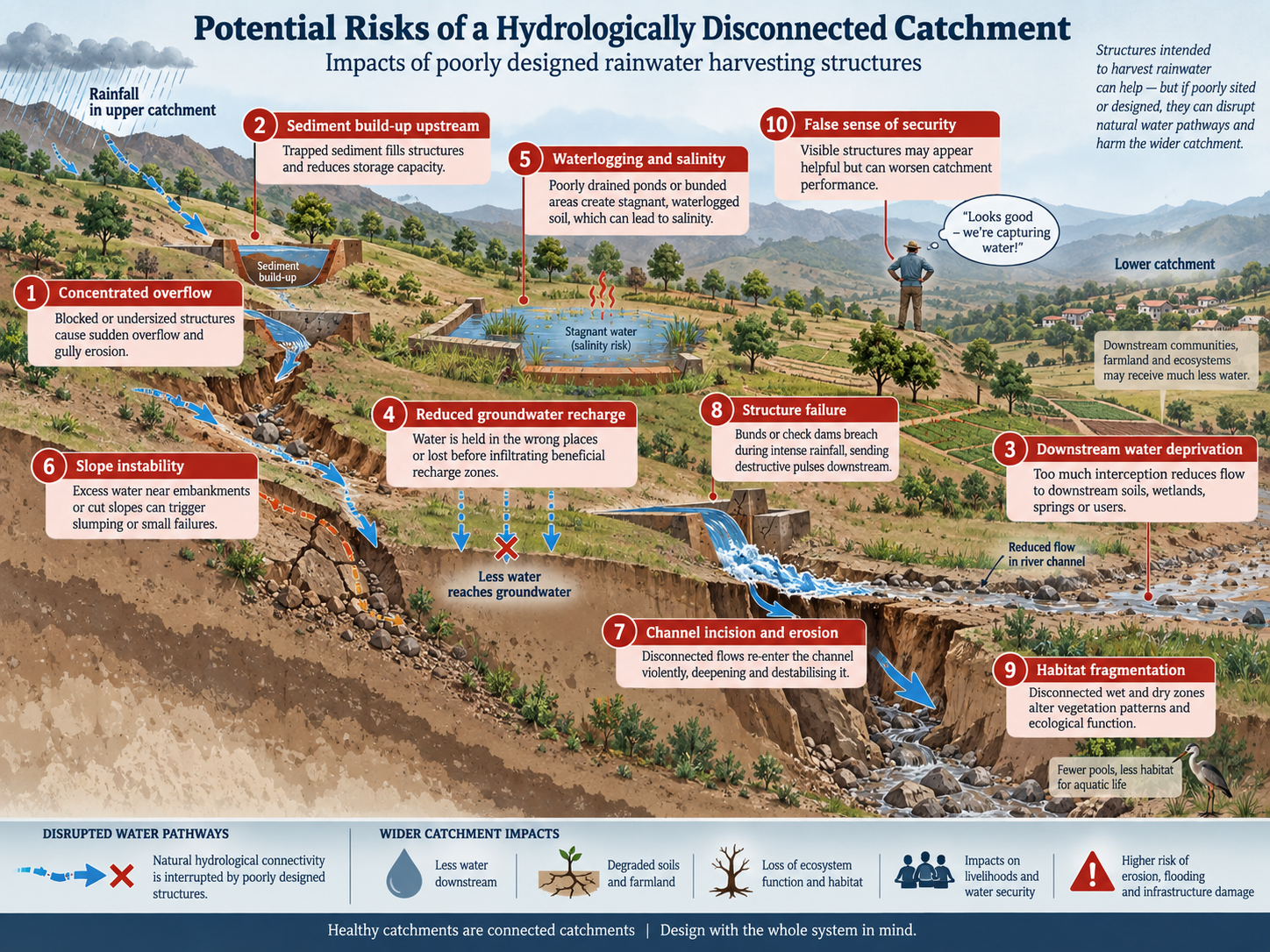
Disruption of Hydrological connectivity and downstream water availability
If you own the top half of the hill and there are people lower down that rely on the water that makes its way down through the property, then you must consider their needs too. The risk here is making life worse for fellow citizens in the locality, you could affect their health and livelihoods by depriving them the water they rely on if they are dry farming or harvesting rainwater themselves.
If your land is higher up in the regions catchment and contributes to larger water bodies further downstream there are most likely restrictions on how you can store captured water, quantities, and how your activity affects its quality. There is another risk here that whatever measures you implement will cause you legal issues if you contravene any of these legal standards/rules on what you can do, meaning forced removal and restoration to the sites original state if the government deems it necessary.
Angry neighbours are a major risk to the project too. No matter how hard it is to combat desertification on a limited budget and against the clock – having neighbours to the land which are against what you are doing will make it infinitely harder. They could block applications and processes for permits to dig/build and planning permission. So, considering what they have received in terms of water throughput historically and making sure the interventions don’t affect them adversely means for an easier life throughout the duration of the project. Conversely, well designed earthworks that provide more & improved quality water supply from higher elevations to lower ones will be welcomed, and could encourage more people who see the results first hand, to get involved too increasing the potential benefits of the project in the long term
Depriving the wrong areas in your own property
Should you add swales and ponds to capture water in higher up spots, on the convex outer curve of the upper slope, you could be holding water there on a poor substrate which doesn’t allow percolation further down to spots where there are heavier deposit of clay and loamy soils capable of storing water where it can be used. Instead, you will end up depriving the naturally moist areas we want to enhance of its best feature as well as adding moisture to a part of the hill, which is most commonly made of harder rock material, not capable of holding much plant life useful to any type of hydrological or ecological enhancement.
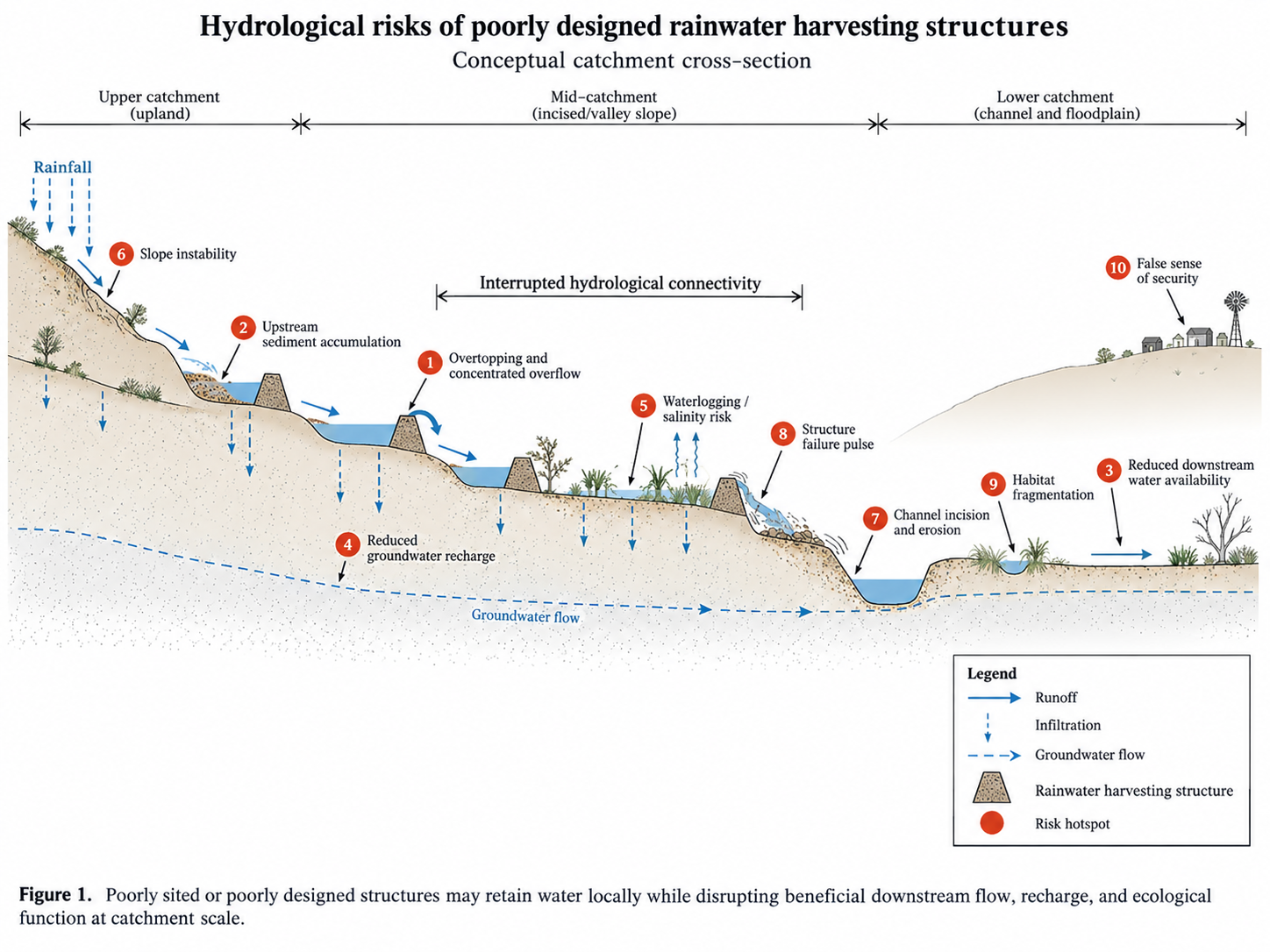
Use of the wrong plants in the site, including invasives
Thirsty plants in an arid environment, as we see with the many huge citrus plantations that dot the region drink more water than can naturally be provided. In terms of ecological restoration, we want to save water that hits the ground and hold it in the ground as long as possible. Having a hectare of citrus trees on one hill and a hectare of esparto grass and natural shrubs on another would highlight the difference in suitability to the environment. The native pallet of plants is going to perspire far less, so that rainwater will last far longer into the dry season than the one of the hillside plantations. More organic mass closer to the ground will hold moisture longer underneath it while shading the sun’s rays off the ground whereas the citrus stand would transpire its water through its leaves and without irrigation, die off. Leaving kindling for the next bout of wildfires to rip through. Ornamental plants are going to be a similar situation. So, the risk presented here is that if you have this opportunity to improve the area, ornamentals and other non-suitable plants, are going to be a net drain on the hydrological equation, sucking up the most valuable resource, and give nothing back to the area, just stopping the more useful plants using that water elsewhere.
Invasive vs non invasive species, and the functions they perform. By not doing the due diligence when it comes to design of the earthworks once the heavy lifting is done, all the hard work done during the construction phase could be undone by planting the wrong species at the end of it. E.g. If you planted elephant grass at the riparian zone to provide habitat for nature and cleaning the water as it reaches the ponds lower down, soon the area with the newly wet conditions will be inundated with a similar looking grass that grows 3 times as high, and spreads uncontrollably, smothering out its competition and having no natural wildlife to control its proliferation.
Similarly planting eucalyptus was seen as a great idea in the 19th century when there was a drastic population shift away from rural areas towards the cities. It’s a fast-growing low maintenance tree providing valuable timber quickly. What wasn’t as obvious at the time, was the impact it would have on its competing neighbouring plants. The Eucalyptus trees which thrive in arid conditions can in some cases consume huge amounts of water very quickly, leaving the other native plants dry. Due to its rapid growth, it shades competitors out, and to top it all off - Eucalyptus is one of the many species of plant that changes the soil around it chemically (Allelopathy). Effectively poisoning the plants around it to create its own monoculture. Because the plants that evolved in the Iberian Peninsula have never encountered this before and evolved in local conditions, they have no natural defence, or way to compete with these trees.
Another issue with invasive species is that they can offer no benefit to wildlife we share the landscape with. Thinking selfishly, lower biodiversity and lower populations of wild animals mean less help with the spread of native plants, and less progress overall in terms of restoration to what the land was like before humans stripped it bare. Again, thinking selfishly – you need natural predators to proliferate to control populations of pests. Something which we appreciate when trying to relax and eat alfresco and end up sharing our food and drink with every fly in the local vicinity.
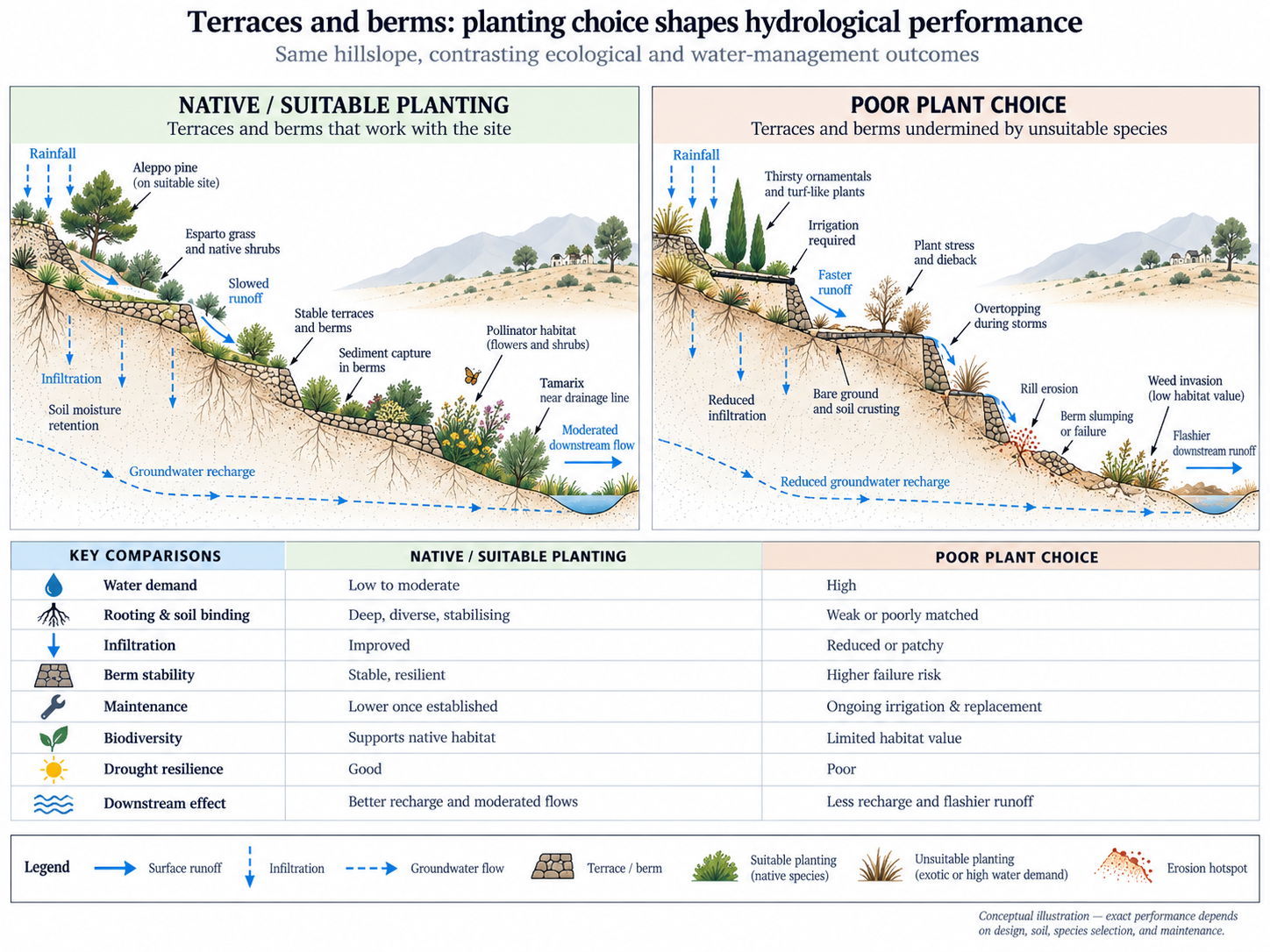
The Danger of Concentrating water
Too much water in the wrong substrate leading to head-cutting
When overflowing happens where there is no spillway protection, this kind of mistake happens all the time and the results can be devastating. If there isn’t a specific designed spillway with erosion protection on the downslope side then concentrated erosion will occur, it’s always faster than people realise until its too late. The structure will blow out and take debris with it at high speed to the next obstacle in its path. Usually another berm or dam, a road or a building.
Looking at a drop in a gulley with a Zuni bowl at the bottom vs one without clearly demonstrates over a reasonably short amount of time that the protected drop has little to no damaging erosion, and the head cutting one is always eroding the face of the drop back upstream, as well as making the gulley deeper.
Stagnation in ponds sealed too tight, or being held in clays where you want leakage – in these types of situations, the onset of trouble is delayed. If the intention of the pond is groundwater recharge - Excess water has been captured and stored so the intervention looks as though its working as intended at first. The issue with non-permeable water storage structures is no movement is also bad. If you have a pond that doesn’t allow some water to slowly permeate into the ground, its positive impact on the surroundings is limited. If it then becomes stagnant it could harbour harmful microbial life so become dangerous if animals consume it. We want water to pass through our environments just slowly so it can be used as much as possible. A static pond full of water unfit for use is a wasted resource, carrying the risk of contamination & PH swings having a negative on the surrounding area.
Its worth noting that a pond intended to not leak any water for things such as stormwater attenuation, or wildlife would therefore be working as per the designer’s intent.
Flooding the wrong parts causing damage or pollution to agricultural plots
Dependent on the crops or existing ecology, inundation for long periods of time can kill off trees and plant life then leave the area barren.
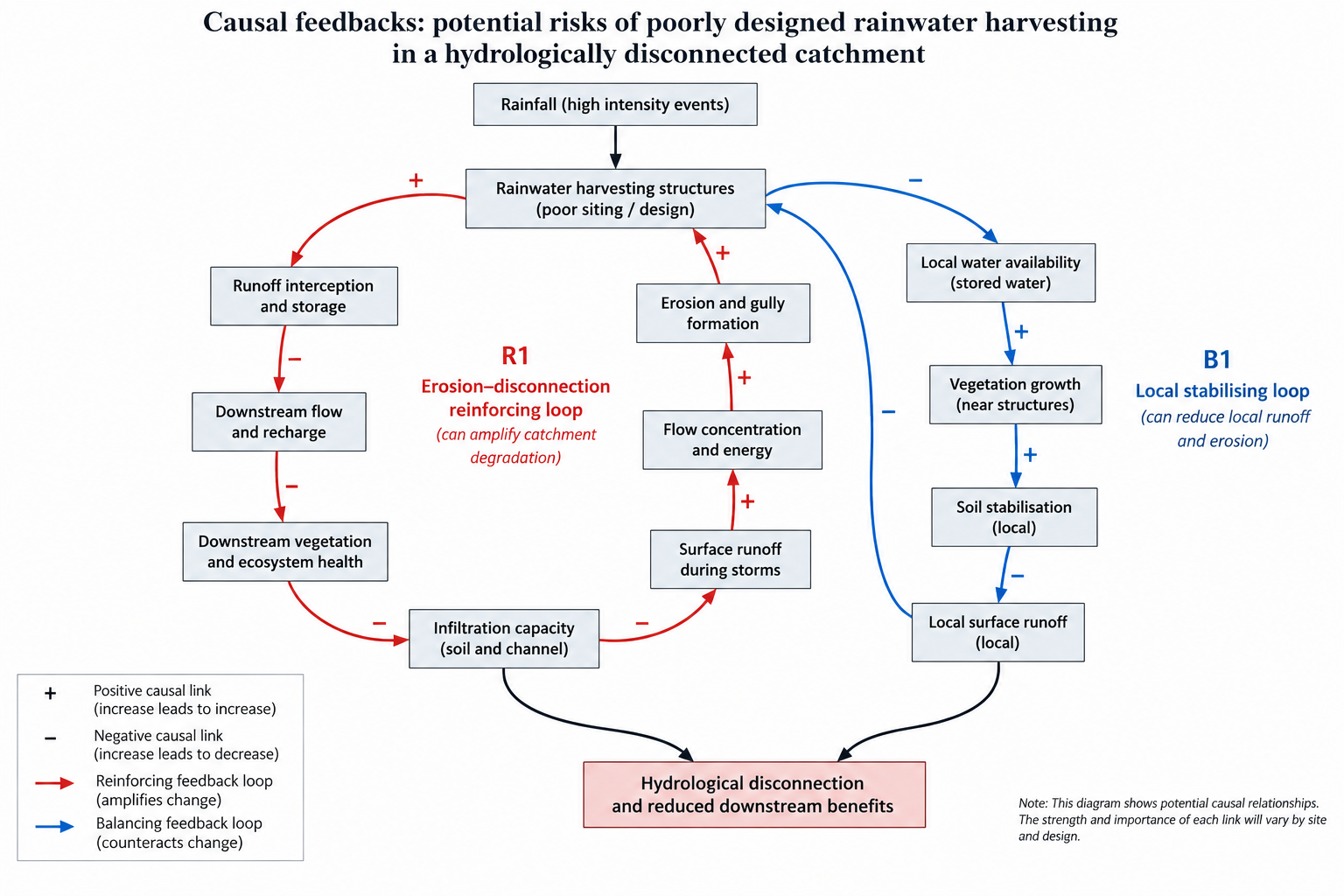
Sediment trapping, storage exhaustion, and remobilisation
Following from the previous point, the ongoing commitment needs to be stated and understood with regards to Sediment build up. By design we want to slow water and drop the sediment it carries. The brown torrents of water we see in the floods are carrying tons of sediment being ripped away in every rainfall event. As this builds up and makes the structures redundant, either newer ones need to be added, the existing ones need to be amended to reflect the new waterway levels and continue the good work, or sediment itself should be removed. Failure to do this will cause the positive feedback loop to become a negative one again.
I.e. water overtopping > incision into the drop >undermining of the structure > structure failure > large pulse of sediment and water flows rapidly downstream
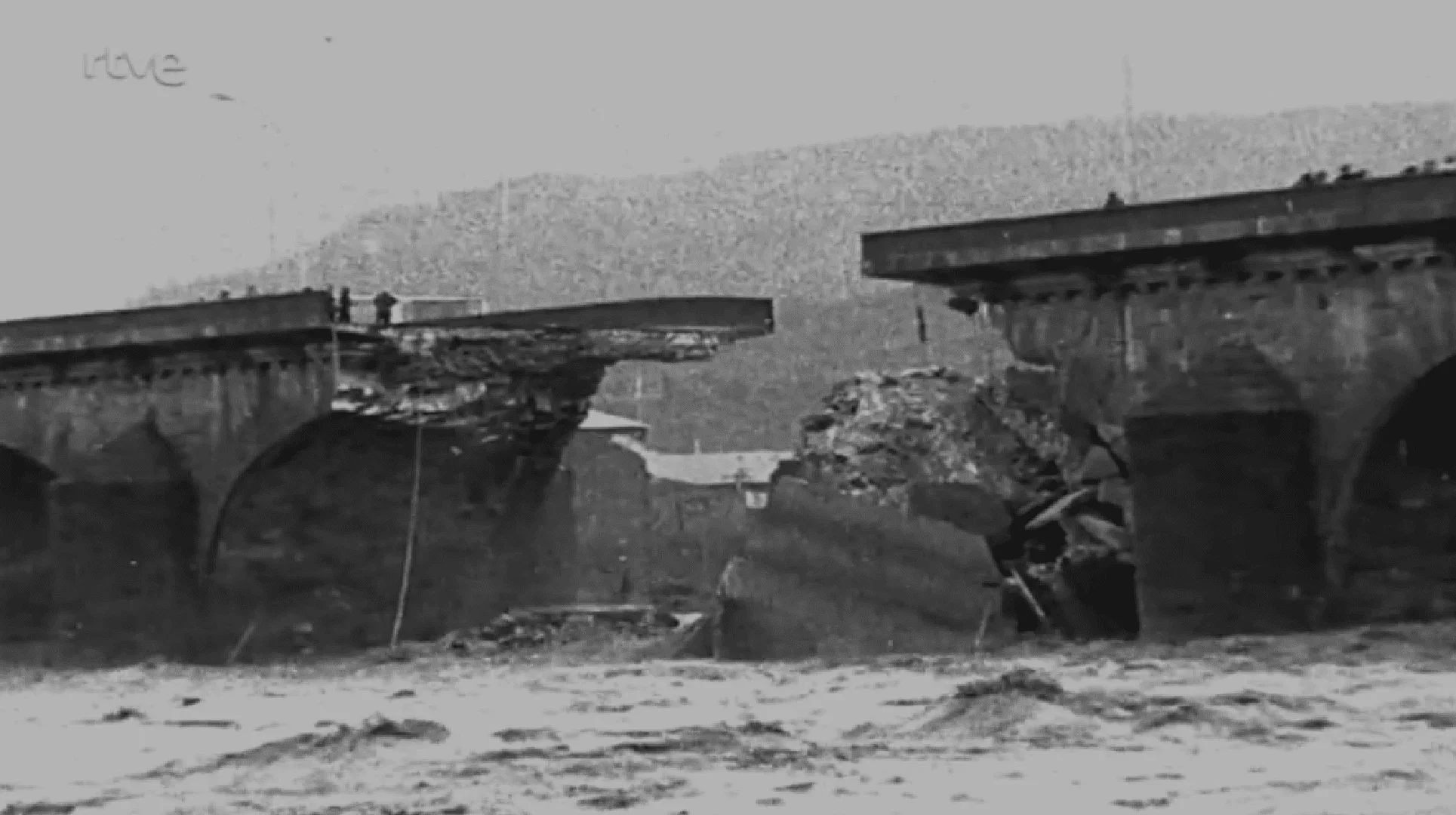
Catastrophic failures and the consequences of them
Dam failures in general – Dependent on the size of the structure, and the volumes of water intended for storage – the bigger the volume of water is the more calculations, materials and complexity of construction is required to store the water safely. A badly designed dam or poorly constructed dam, if big enough can wipe out a whole city. Some examples are listed here:
A couple of Historical Dam Failures
South Fork Dam / Johnstown Flood (United States, 1889): Heavy rainfall combined with poor maintenance and unauthorized structural alterations led to an earth-fill dam collapse that killed 2,208 people in Johnstown, Pennsylvania, making it one of the worst flash-flood disasters in US history.
Derna Dams (Libya, 2023): Torrential downpours from Storm Daniel overwhelmed two upstream dams near Derna, sending a massive wall of water through the coastal city and causing devastating loss of life and infrastructure.
Locally in Huercal-Overa a common sight is roads across ramblas being washed away following a heavy episode of rain. Again, if these were designed to be able to cope with these larger events, they’d not need to be rebuilt so regularly. But cost must be factored so maybe that’s why they aren’t.
Maintenance requirements that people don’t like to do or pay for – the enthusiasm people have when designing and building dams quickly fades away but they are a piece of infrastructure with great hydraulic power behind them. Water degrades everything and over decades, any structure needs maintenance which increases in cost and complexity the bigger they are. If the cost and effort required to maintain them is an afterthought then failure is a matter of when, not If.
Designers need to consider the fact that rivers and waterways aren’t static, they meander and change. Growing and shrinking with each season reacting to floods or droughts. With restoration structures – we want them to sediment up and grow plants in them with the root penetration and land use changes that come with it.
In conclusion…
the risks associated with poorly designed and built restoration interventions on ephemeral can be huge. That’s why the mantra through the design process is many smaller and more economically viable measures rather than one or two larger ones. Smaller usually means lower barrier to entry in terms of technical ability of the builder and maintainer. Rebuilding them is expected once enough sediment is captured and the floodplain is widened into a terrace of fertile soil. Failure is not only accounted for as a % of risk but is planned for. With remediation if required afterwards. Our style of water harvesting and restoration is to restore the land to what it used to do, act as natural flood plains at the lowest elevations and a sponge for transient water everywhere else above it, the ultimate marker of success is for the excess to then re-appear in springs or returned permanent streams accessible to everyone. The aim is not to create huge reservoirs everywhere and hold water for use by a select few people.
Hydrological restoration structures should be designed for safe exceedance, so that any events beyond their designed max capacity will result in a controlled overflow and limited, repairable damage – rather than a cascade of ever increasing failures.