11. Islands of fertility concept
My idea of how to approach the Seasonal flooding issue in Huercal-Overa and its surroundings is by creating many small localised "Islands of fertility", small dedicated zones of acquired land (of which is usually abandoned) left to be washed out by every flood and turning them into the distributed infiltration and retention zones intended to increase the proportion of stormwater retained within the landscape the area is missing.
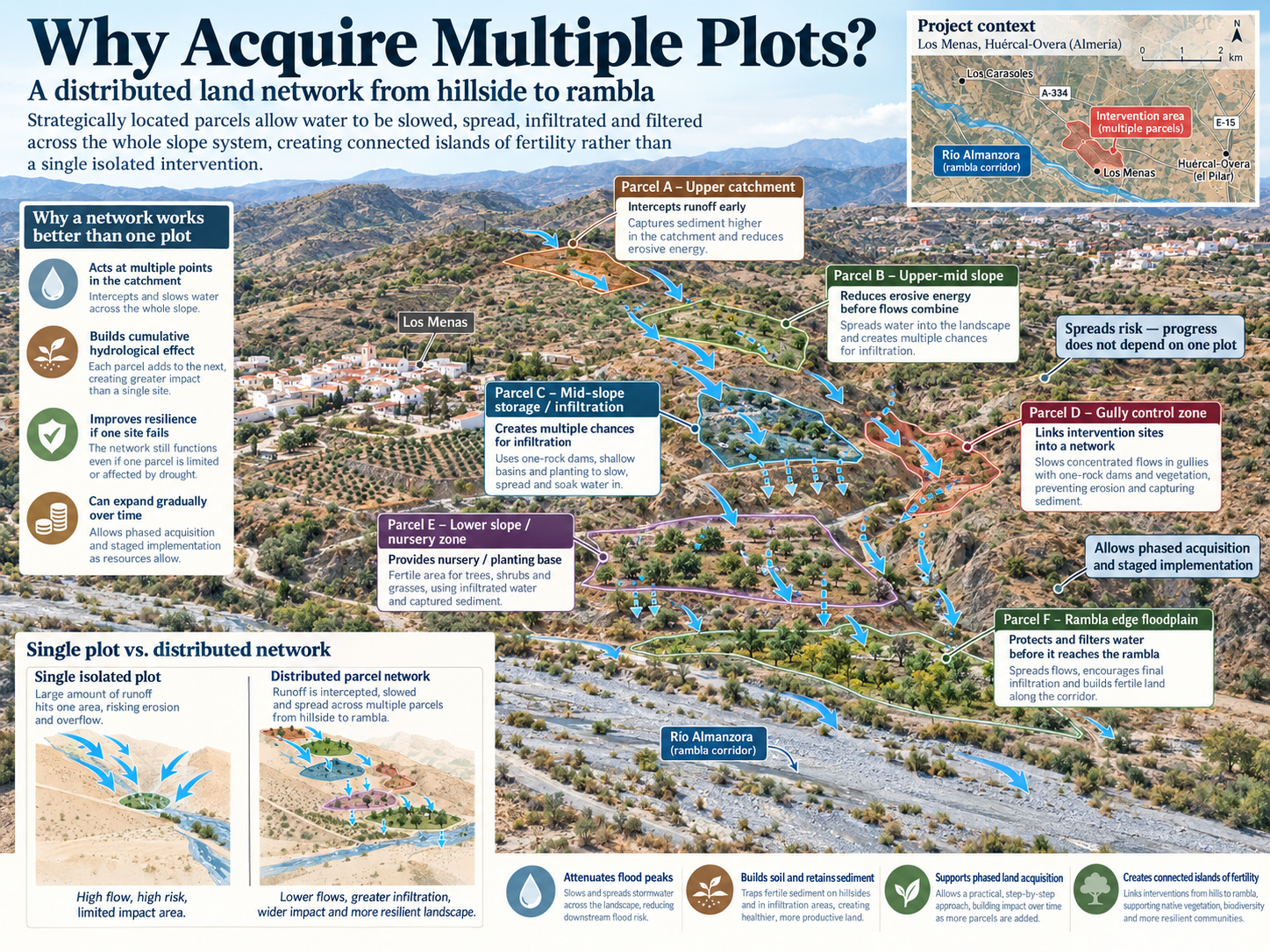
Diagram of the interconnected parcels idea working together to enhance the one larger system.
By optimising it for flood attenuation, installing baffles in high flow areas that are specifically designed to absorb and dissipate energy for fast flowing water, the idea is that the sediment being carried (along with pollution and debris) is all deposited in these areas. The waters should lose some of that brown colouring we typically see as well as their erosive energy. The particles settle in and around the boulders/gabions and whatever else we place in the way and build up deposited fertile soil which then is a perfect site for plant life to grow in place ready for the next event.
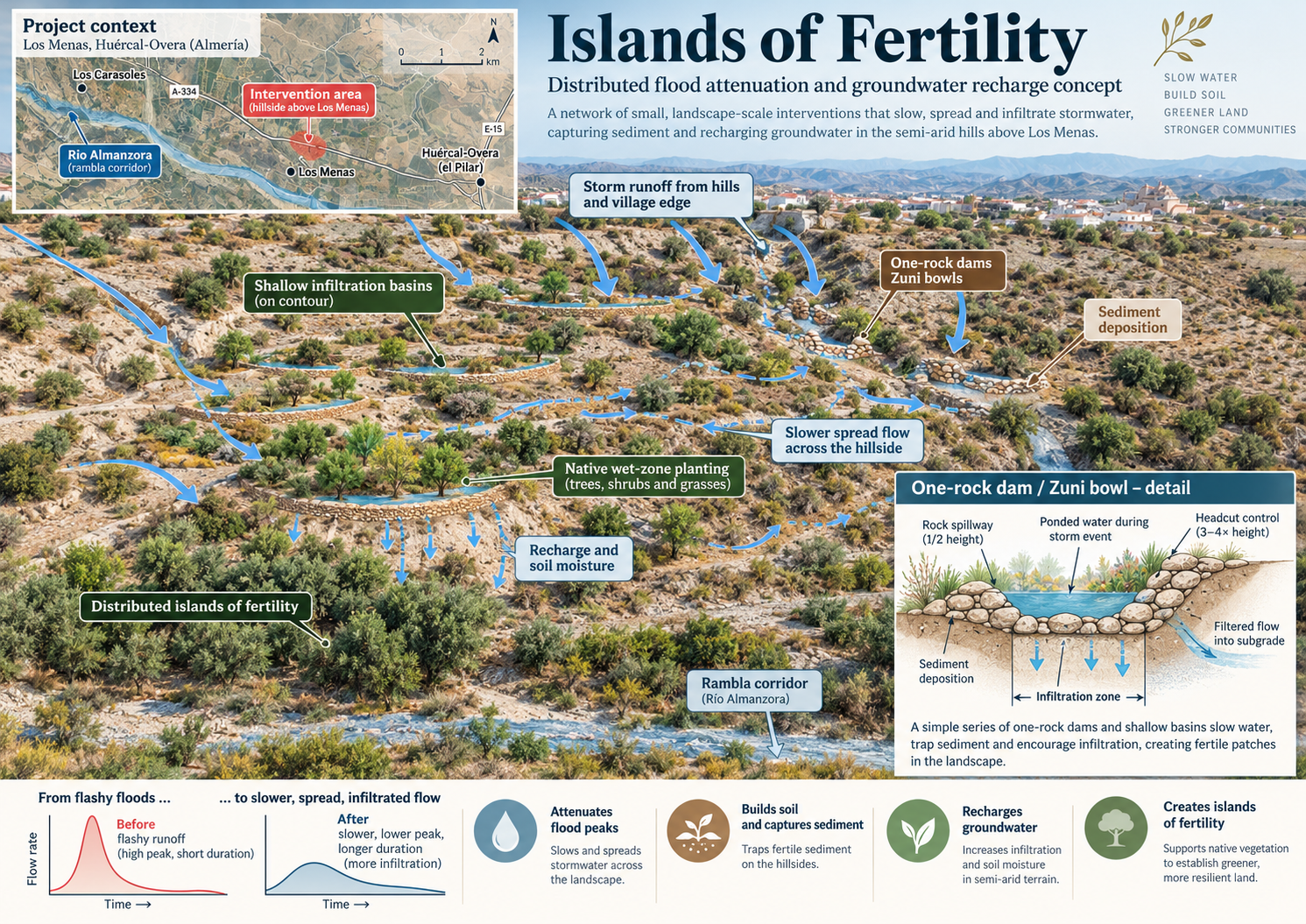
An illustration (by ChatGPT) of the idea of these smaller islands of fertility dotted around the local area.
Once the physical measures that slow the water down are in place, and the Hydrological conditions are altered, then the strategic planting can be done to both slow down more of that faster flowing water and filter it by planting native riparian plant species like sedges and rushes native to the region, Which thrive by filtering the dirty flood water, their root networks help break down the hardened baked clay surfaces and sink the water downwards instead of flowing horizontally and creating a sponge that grows in size slowly with each storm that hits.
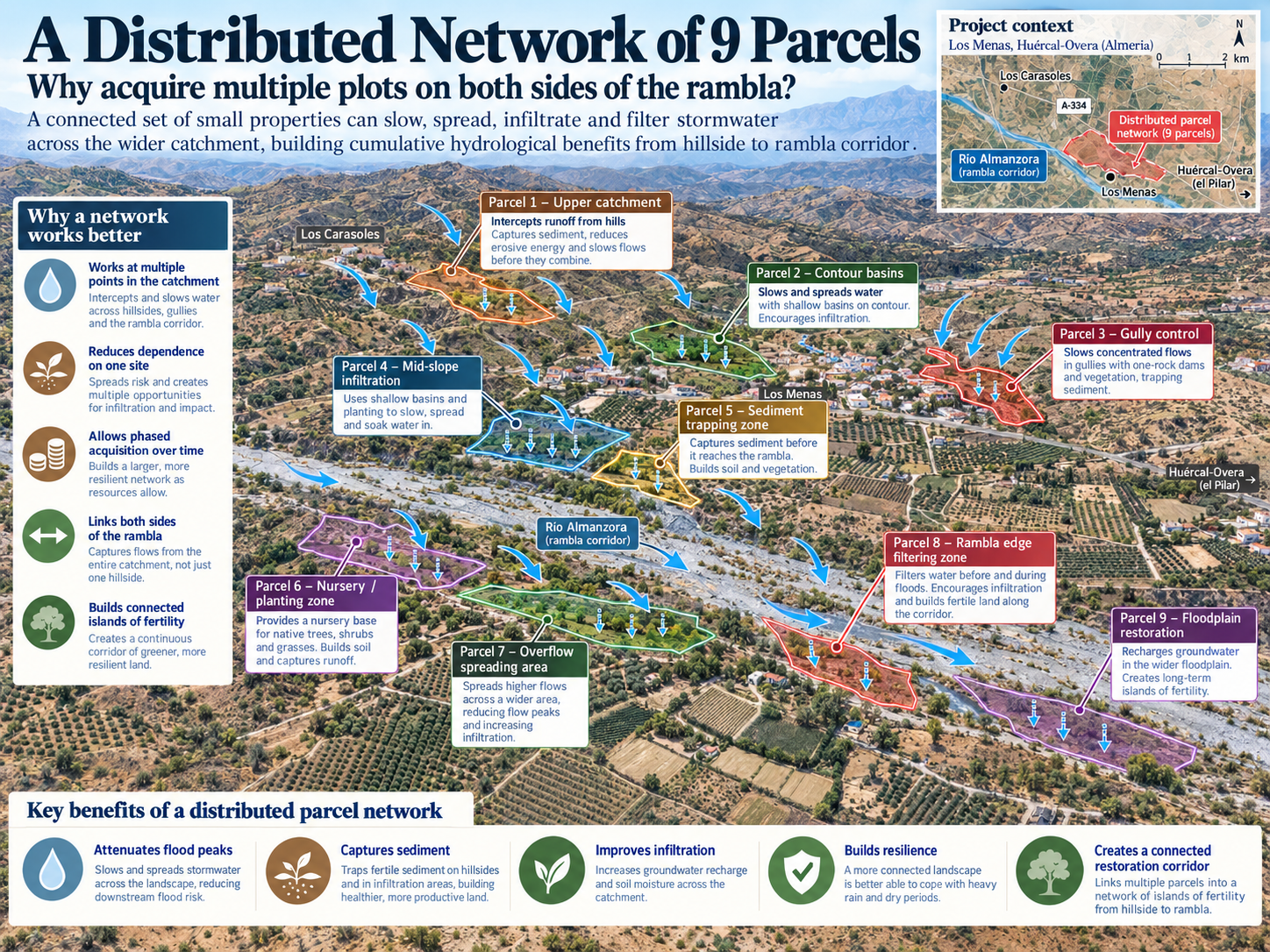
An Example showing the benefits of in this scenario - 9 smaller plots of land rather than one large connected one.
Another benefit of this approach is that more of the area of the rambla which is otherwise unusable becomes more useful to its surroundings. A stretch of rambla which is dry most of the year round being 10M wide is hardened and incised into the ground forming the lowest point of the valley it passes through, it could be surrounded by 300M of degraded land each side which occasionally receives a flood in the peak events but not as regular as the lowest parts of the rambla. By slowing the water as it hits and spreading it over a larger area -e.g. from a 10m wide section, making it 30 meters for that stretch would increase the surface area by 3 times, adding more friction to slow that water down and allow deposition of silt. Eventually the soil will build in this now 30M wide section behind the rocks etc building a natural looking terrace which holds water for potentially months before it seeps away. Grasses and bigger shrubs can colonise it giving stability, anchoring it there. For following events this section of ground is now an asset hydrologically speaking.
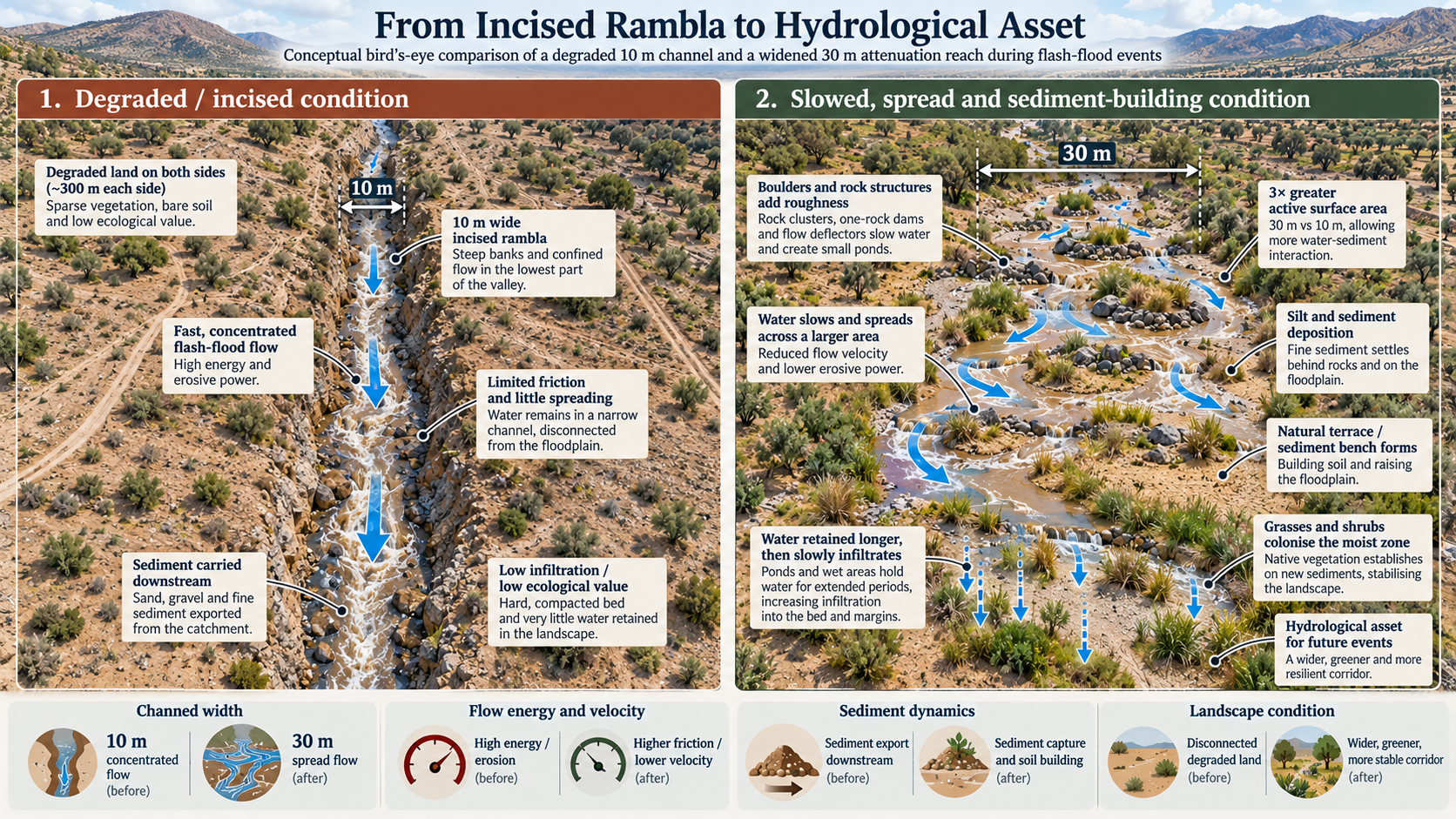
Comparison of the 2 scenarios in a hypothetical section of the rambla. Left is untouched and Right is with the interventions mentioned in the article.
By doing many smaller intervention sites, my hypothesis is that they will slowly grow in key places and eventually a snowball effect will occur where the benefits of one area spread to others. Eventually you have joined up natural living infrastructure which can help dampen the worst pulses of flood water and release them slower than the surrounding areas.
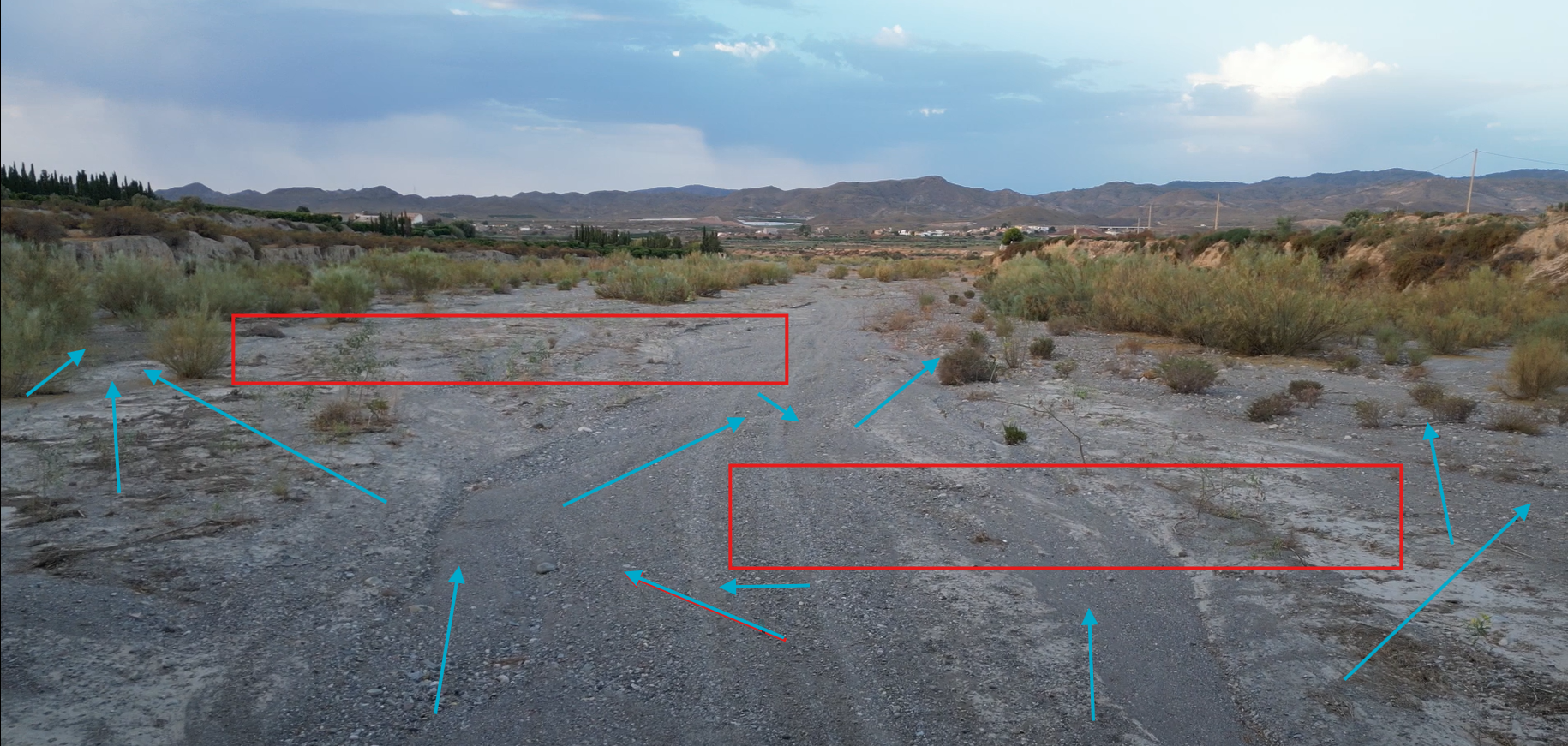
Very rough illustration showing on a picture taken from the rambla by Los Navaros, where by Placing Baffles of Boulders and rocks in the highest flow areas (deepest tracks of erosion) they will absorb some of the waters force and drive it around them. by slowing it down it has more time to sink in a wider area which is available here, and will enable more vegetation to grow in place providing more resistance later on.
By doing this as high up in each catchment area as possible, we are adding a natural delay to the pulse of water from a rainstorm meaning the rambla doesn’t swell up with biblical looking floods every time we receive rain, instead of a monthly tidal wave every wet season, eventually it could build up to a (much longer duration) flowing stream which is allowed to naturally flood gently over a wider profile when huge amounts of water are deposited. The same amount of rainwater will then be more of an asset than something to be prepared for because of the damage and destruction that often comes with it.
The smaller, distributed zones of earthwork-Hydrological interventions are therefore an experiment which if it’s successful, make abandoned parcels of land become a natural asset, addressing drought issues, wildfires, floods and lack of biodiversity.
By funding privately and independently, then carrying the work out ourselves - we aren’t waiting for the government to get on board, to stay consistent with the programme to implement the measures quickly enough for us to see the benefits, turn the project into a commercial quagmire that their friends and associates see as an opportunity to profit from and all the other roadblocks they seem to hit when undertaking anything to do with the environment. We are acting quietly in our own best interests as quickly as we need to, to get the results.