6. ¿Cuáles son los principales bucles de retroalimentación que impulsan la degradación hidrológica en los paisajes semiáridos?
Nota sobre autoría: Este artículo ha sido investigado, estructurado y escrito por el autor. La inteligencia artificial se ha utilizado únicamente como apoyo para la traducción al español y la generación de algunas imágenes ilustrativas. Todo el contenido y las conclusiones han sido revisados y son responsabilidad del autor.
En este artículo intento desglosar los principales bucles de retroalimentación que están impulsando la evidente degradación hidrológica del entorno semiárido de la cuenca del río Almanzora.
Analizo el uso del suelo como una de las primeras alteraciones del ciclo, la reducción de la vegetación, el concepto —algo controvertido— de la bomba biótica y, finalmente, los cambios en el albedo y la forma en que estos procesos pueden formar sus propios bucles de retroalimentación y, al mismo tiempo, integrarse dentro de otros sistemas más amplios.
Los efectos del uso humano del suelo, especialmente los impactos de la agricultura intensiva
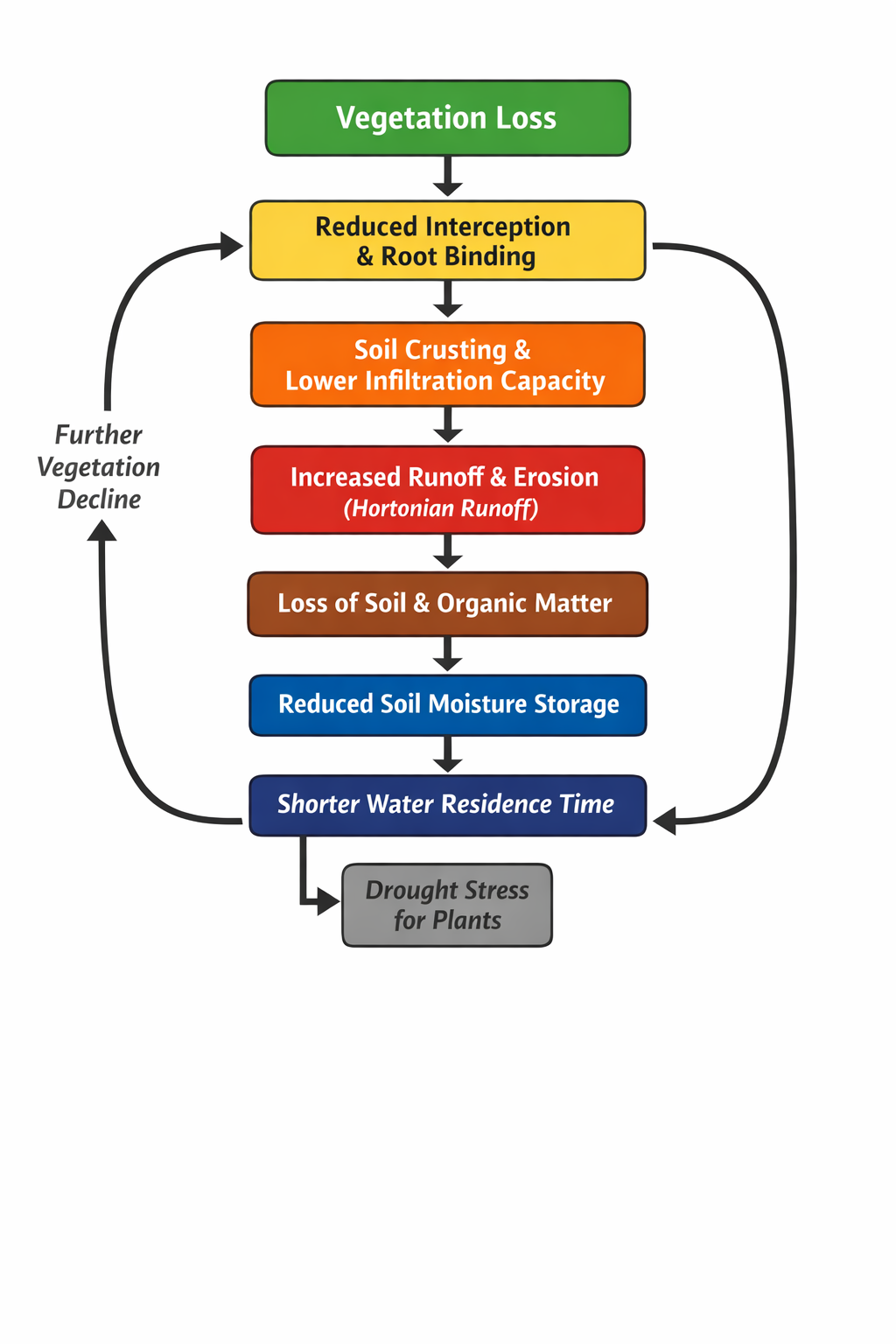
Deforestación > erosión > reducción de la infiltración > mayor pérdida de vegetación > erosión > reducción de la infiltración…
El impacto histórico del uso del suelo en el Mediterráneo ha sido ampliamente debatido.
Una buena síntesis puede encontrarse en el trabajo de Karl W. Butzer, Environmental history in the Mediterranean world: cross-disciplinary investigation of cause-and-effect for degradation and soil erosion (doi:10.1016/j.jas.2005.06.001).
Este trabajo muestra que, desde la década de 1960, numerosos estudios han tratado de determinar hasta qué punto aproximadamente 8.000 años de actividad humana y cambios en el uso del territorio han contribuido a su degradación.
Existe un amplio consenso en que gran parte de los bosques originales que antiguamente cubrían la península ibérica han desaparecido, predominantemente como consecuencia de la actividad humana, aunque determinados fenómenos meteorológicos excepcionales pueden provocar una devastación considerable independientemente de la presencia humana.
Sin embargo, estos acontecimientos extremos representan la excepción y no la situación habitual.
Un territorio deforestado y posteriormente utilizado como pasto para el ganado puede parecer verde y saludable gracias a su cubierta herbácea. Sin embargo, el pastoreo puede impedir que árboles y arbustos de mayor tamaño vuelvan a establecerse.
Esto puede iniciar un bucle de degradación:
Deforestación > erosión > menor infiltración > pérdida adicional de vegetación > mayor erosión > menor infiltración…
Históricamente, las actividades humanas necesarias para la subsistencia y la supervivencia han dependido de la tala de bosques, del uso de la madera para construcción y combustible y de la utilización posterior de las tierras despejadas para cultivos y pastoreo.
Este representa el primer paso de este ciclo de degradación.
El siguiente paso se produce cuando las mismas condiciones meteorológicas y las mismas precipitaciones empiezan a interactuar con un territorio muy diferente.
Anteriormente, una parte de la lluvia era interceptada por las copas de los árboles, reduciendo la energía cinética con la que alcanzaba el suelo. El agua podía descender por las ramas y los troncos hasta la base de los árboles o caer gradualmente desde las hojas dentro de la zona situada bajo la copa.
Una vez eliminada esa cobertura vegetal, la lluvia golpea directamente el suelo después de haber adquirido velocidad durante su caída desde las nubes.
El impacto sobre el suelo desnudo y las rocas transmite mucha más energía cinética a la superficie, favoreciendo procesos como la erosión por salpicadura y la formación de costras superficiales (véase Soil Crusting).
Como consecuencia, el agua dispone de menos tiempo y oportunidades para infiltrarse en el terreno y comienza a desplazarse ladera abajo con mayor rapidez.
Repeated in every storm, or rain shower the impacts begin to snowball getting worse with each cycle, changing the capability of the land to absorb each storm. This itself over millennia is a cyclical process degrading and aggrading over time with periods of intensification and collapses where nature gets a chance to regenerate, but its overall a declining trend looking over the anthropogenic (Human) timescale.
The Aeolian effects (Wind erosion) also become a bigger issue when deforestation has occurred. Wind once stifled by vegetation, capturing dust particles, are now able to scour the ground unabated, picking up and hurling the dust at the next hills and rocks in its path, which as well as causing more erosion, also greatly increases the soil evaporation rates in the area. (See Forest evapotranspiration trends and their driving factors under climate change - ScienceDirect for a deeper explanation of the possible influence caused by deforestation to evapotranspiration trends). This is part of a loop of further drying out of the ground. This in turn leads to lower Evapotranspiration in this case, meaning lower humidity, and less local rainfall contributions. Simplified this loop is:
Vegetation loss > lower transpiration > lower atmospheric humidity > less local rainfall recycling
The impact of reduction in Land-Atmospheric Coupling (Biotic pump activity) due to deforestation and degradation.
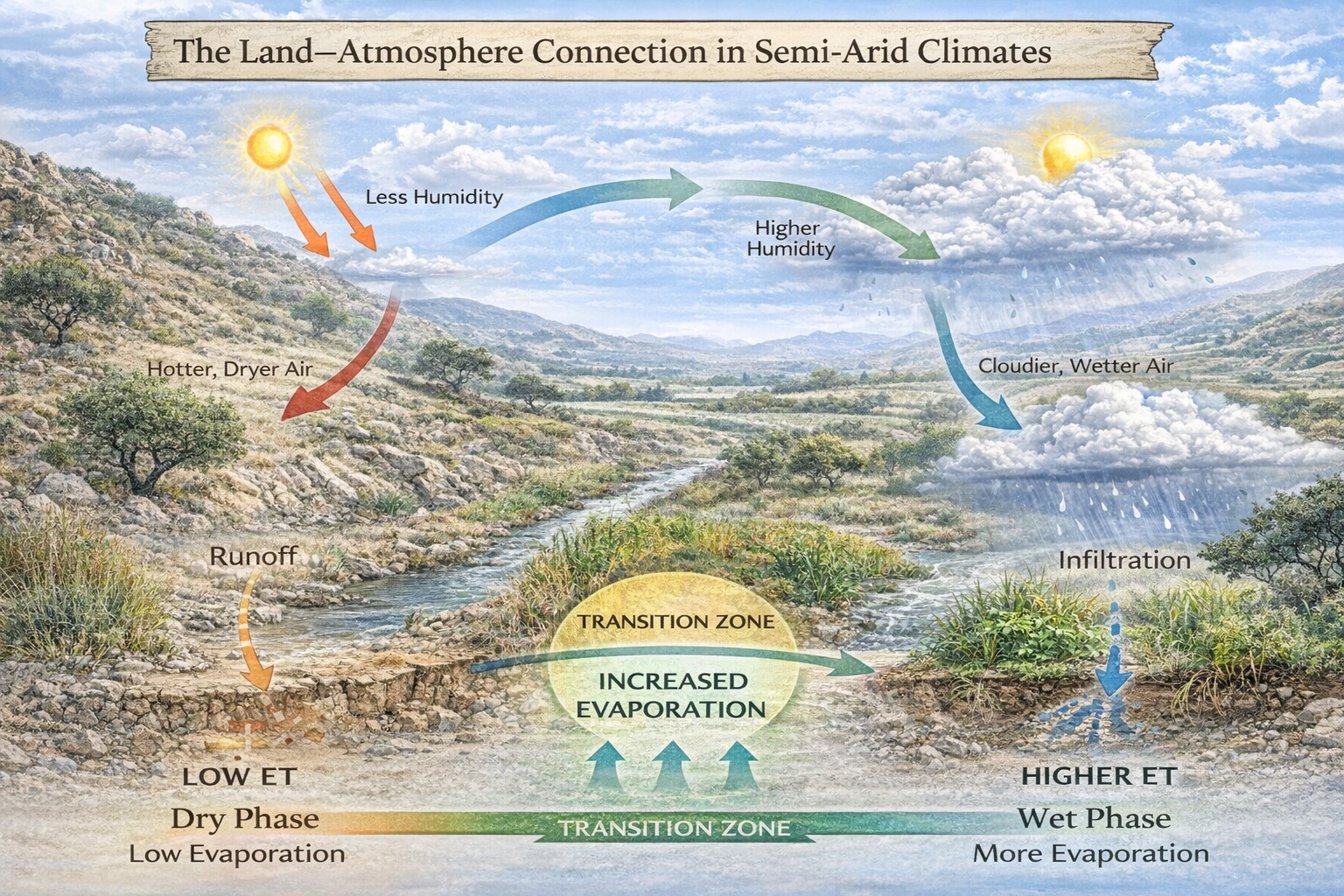
Land atmospheric coupling is a theory held on the connection between Land and atmosphere processes which influence atmospheric moisture, the energy balance and precipitation. Its generally a more accepted framework than the ‘Biotic pump’ idea originally put forward by Anastassia Makarieva and Victor Gorshkov, and analysed in the paper Winds and rain: the role of the biotic pump Volume 6 Issue 5 - 2020 Peter Bunyard Independent research which in a nutshell proposes that forests contribute to local rainfall via high rates of evapotranspiration and also generate the winds that carry them. The Land Atmosphere coupling model is more modest in its claims, but the underlying processes are very similar, in terms of precipitation > interception by vegetation > infiltration into soils, evapotranspiration back into the atmosphere > precipitation further inland. Logically it follows that if we remove the inland ability to keep cascading water further inland then the interior landmasses will eventually all be affected with reduced rainfall further exacerbating the issue. Lower soil moisture leads to less evapotranspiration, meaning lower humidity in the low atmosphere close to the ground, leaving the energy potential of the moisture in the system tending towards even higher E.t rates. These loops are far more consequent in tropical forests than Mediterranean ones, there is still a measurable weakened land-atmosphere moisture feedback loop.
Ground Erosion
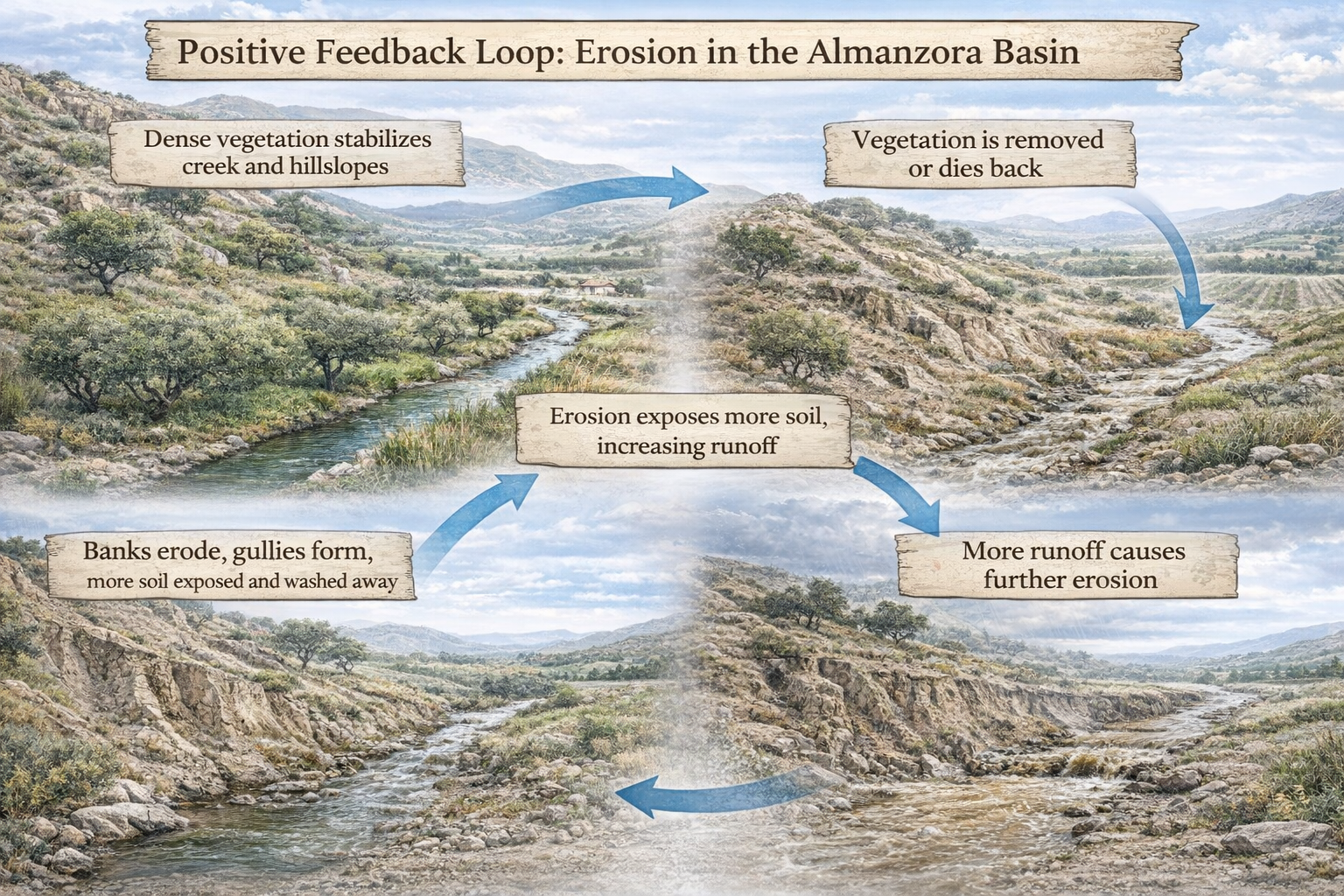
As mentioned earlier ground erosion is another negative feedback loop affected in the area, as the planet warms and we reach/pass climate tipping points the climate swings become more extreme. Extreme weather events have been steadily increasing in severity and quantity (parasol-lost.pdf - Parasol Lost: Recovery plan needed Global risk management for human prosperity). From the flash floods filling newsfeeds numerous times yearly now we see that the water is almost always full of carried sediment. The amount of damage to the landscape is unmeasurable but it leaves a trail of deposited alluvium which infrastructure has evolved to divert away from developed areas as quickly as possible. This scours the land making for deep cut drainage gullies in the land, which stop the next floods to flow down them from soaking into the ground. This lack of infiltration further dries the watershed out and makes the land more susceptible to damage in the next instance. Once in this state its very hard and takes some incredible amounts of damage to rectify itself naturally so will continue to erode the landscape. Here the loop is:
Soil eroded > decreased vegetation to slow water > Flash flooding > heavy erosion > reduced moisture retention & carbon sequestration > Flash flooding > More soil erosion .....
Conclusion:
The Feedback loops above are all negative feedback loops in an interconnected, complexed system. If left alone they will continue in the degrading fashion towards greater aridity, more damage to built natural infrastructure harder to come back from in what seems like a dwindling amount of time to do something about it.