- Organically Written by a human without AI generation
The phrase “Build it right, build it once” is frequently used to explain the lessons learnt from engineering and construction about anything involving earthworks, this would indicate that if you have any given site, the most logical and efficient method to optimise for rainwater capture is going to be build the biggest structures and implement the biggest changes in one instance, to maximise efficiency and get the best ROI (Return On Investment). For there to be a phrase about it, there surely must be some truth to the saying?
In this focused niche area, there is good reason for this: any type of earthwork is logistically challenging, uses plant and tools that aren’t that common and causes a lot of disturbance to a site which takes time to settle after and to recover. Due to their disruptive nature and the fact that once you start doing earthworks on any type of project, your end result is the blank slate to build on – once the next stages of the project begin there is usually no going back, as the ground is beneath everything that follows.
However, this explanation becomes less satisfactory when building structures for hydrological and ecological restoration. In this niche category of projects, the aim is not really for a final, predetermined structure or function that looks as per a fixed design. We are trying to restore function as opposed to form. And the function is a restored unfixed watercourse designed to react, grow and meander if its successful.
An alternative interpretation is that many smaller distributed earthwork structures are actually better for this kind of work. This is due to the fact that no matter how good you are at designing and engineering – nothing ever goes totally to plan, and the outcomes of works of this nature aren’t always as predictable as we’d like.
Rather than treating these explanations as mutually exclusive, this article examines how complexity, Size, and cost interact across the duration of the restoration.
I argue that smaller distributed earthworks are more Suitable than large, engineered solutions for an ecological restoration project, especially when time is the key factor. Time is the key factor, due to the onset of climate change, rapid decline of available fresh water for all human activity, and the rise in the instances and severity of both wildfires and catastrophic flooding in arid/semi-arid dryland environments.
Therefore, while “Build it right, build it once”, is a good maxim to live by in construction and engineering, especially in terms of time, cost and the overall sequence of works in your program, smaller distributed earthworks are optimal in our circumstances for the reasons I propose below. Those being the nature of the work specifically, expectations on performance and the project lifecycle.
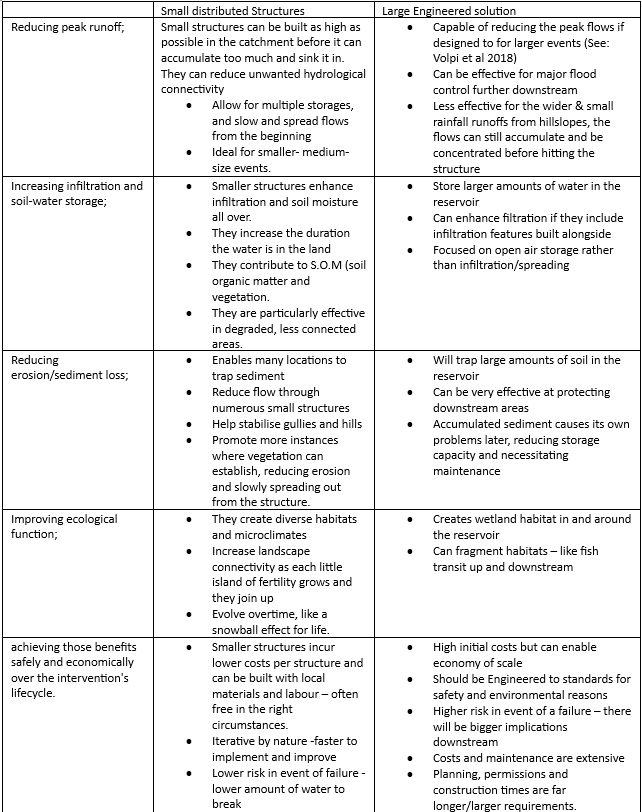
Hydrological Performance:
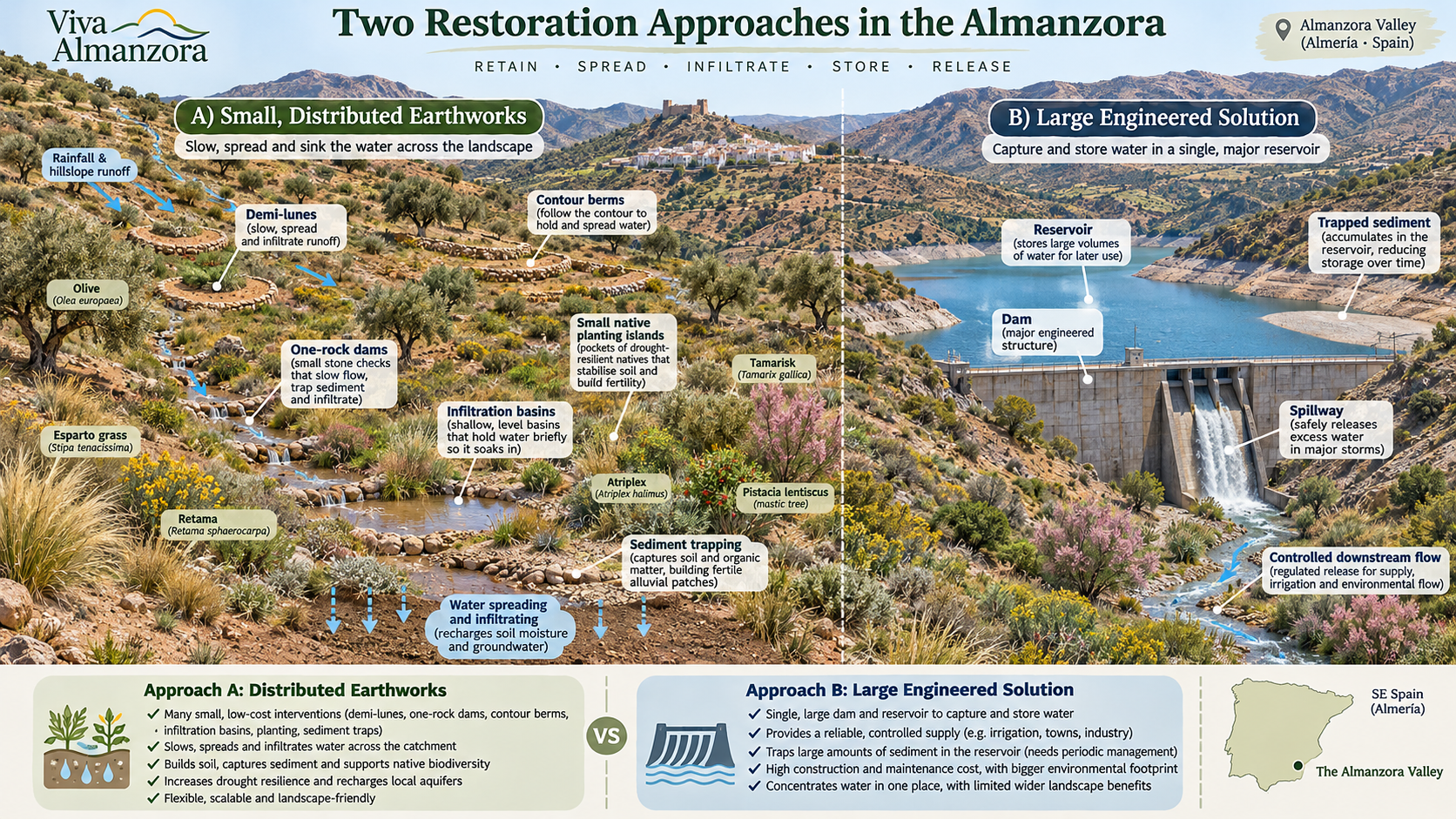
What does existing scientific evidence demonstrate?
Flood Attenuation
o 2 papers I read relevant to flood attenuation are Volpi et al & Bombino et al, conducted in Italy in Semi-Arid Mediterranean environments. Bombino et al, showed 15 check dams in a well forested area with very low runoff were not statistically significant in flood attenuation. They also highlighted the fact that for 8-10 years the sediment captured was significant but after that became a net loss of sediment. from the Volpi paper, their exploration into flood attenuation highlighted that location of the reservoirs reigns most important in this method of water control. These two papers compared highlight that neither approach is as straightforward as it seems at a first glance and that the optimal solution could be a combination of the two approaches, also that forested catchments have less runoff and finally that contributing gullies to the watercourse can nullify the effect of one dam/reservoir. So, to control for this, multiple locations based on site specific analysis across the catchment would be optimal. It also suggests that the ultimate goal - being to replace any structures with built up sand-dams which have levelled a wider flood plain along the watercourse, being planted with native vegetation – is the most effective long-term solution for this project.
Infiltration and Groundwater recharge
o Here the 2 papers I considered were García-Ávalos et al. (2018) & Djuma et al. (2017). To summarise them brutally id, say that the Garcia -Avalos experiment consisting of many micro catchments offered up to 94% plant survival rate in its water harvesting structures which were planted compared to 40% in untreated areas. Comparing this with the other study conducted in an ephemeral riverbed in Cyprus, in which a gabion-check-dam structure was able to recharge the aquifer by 30% additionally stored water from its total throughput over an extended period. Suggesting again a mixture of different methods strategically placed would be the best approach to gain maximum return on investment later on.
Sedimentation and long-term management
The 2 papers I considered for these criteria were Castillo et al 2007 & Garcia-Lopez et al 2025. Castillo et al showed that multiple check dams filled with sediment over an extended period of time, building up the channel upstream, widening it and remediating heavy erosion and steepness in gullies. There was some greater erosion immediately downstream of each feature, but it evened out to net gains overall project wide.
In terms of long-term water management, the findings from the Garcia Lopez paper showed that surface evaporation alone can make up from 30-55% of water losses overall. Suggesting water held in the ground distributed across the catchment is more reliable and cost effective per litre sequestered over time.
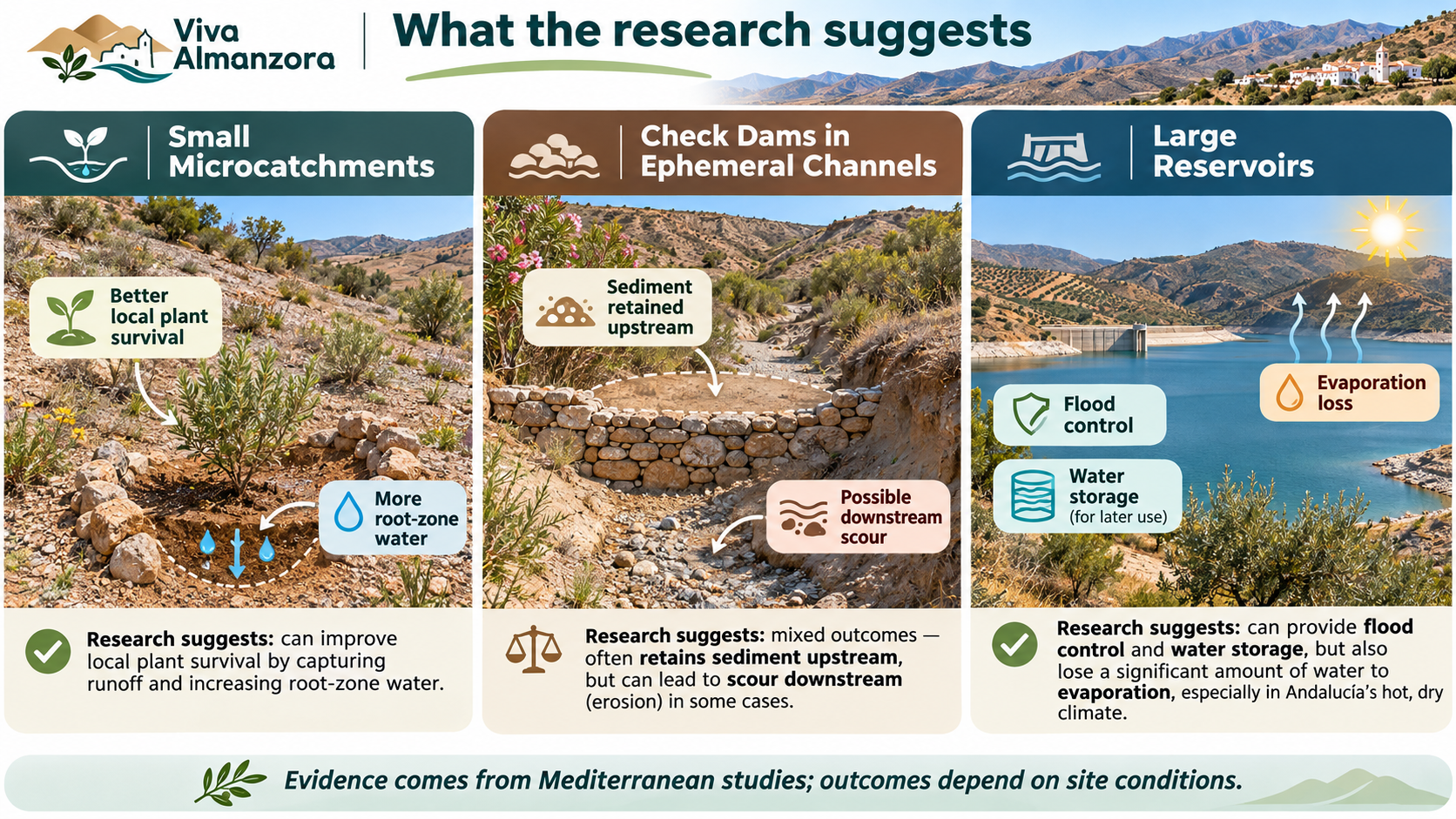
Time – how long do you have? is there a time constraint? do you need results by a certain date?
Our understanding of time as a constraint on restoration takes different forms. Overall, there is the sense that we are living on borrowed time, that we have passed certain tipping points of no return with regards to the environment and our dependence on fossil fuels and fossil water (ancient water stores in aquifers. By their nature they are finite. If we as a species continue to live in the way we do, consuming at a rate that outpaces their replenishment - then at some point we shall run out.
Statistics and models of climate change also indicate that we have until 2050 to reach net zero carbon emissions, and until 2030 to reach 50% of current levels, giving everyone a sense of urgency but not necessarily making it easy for the common person living their lives to make any tangible difference.
Time in terms of a small restoration project meanwhile is a little more tangible. We have for example maybe a year to prepare agricultural land for the next rainy season and the summer following, to capitalise on as much gains as possible to improve quality of life for the residents, and crop yields.
If you want to plant trees that shade a building from the intense sun, the best time to plant them is 20 years ago, and the next best time to plant is now. In terms of earthworks such as berms and swales, digging them out and building in the dry season, means not long until you get to see them in action during the subsequent wetter colder period. (Although depending on climate conditions it could be the worst time to plant anything in them due to the E.T, rate in the height of summer.)
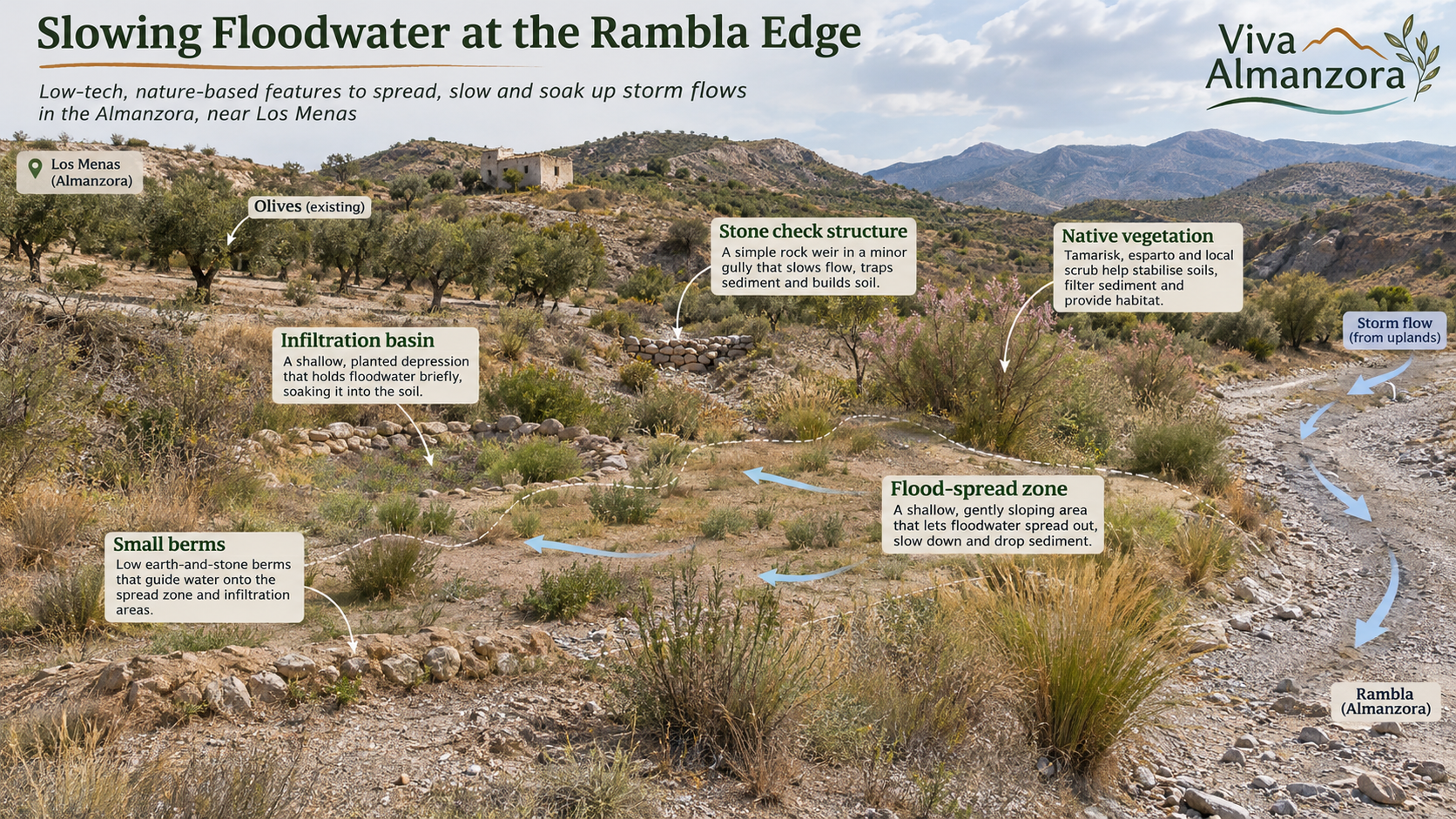
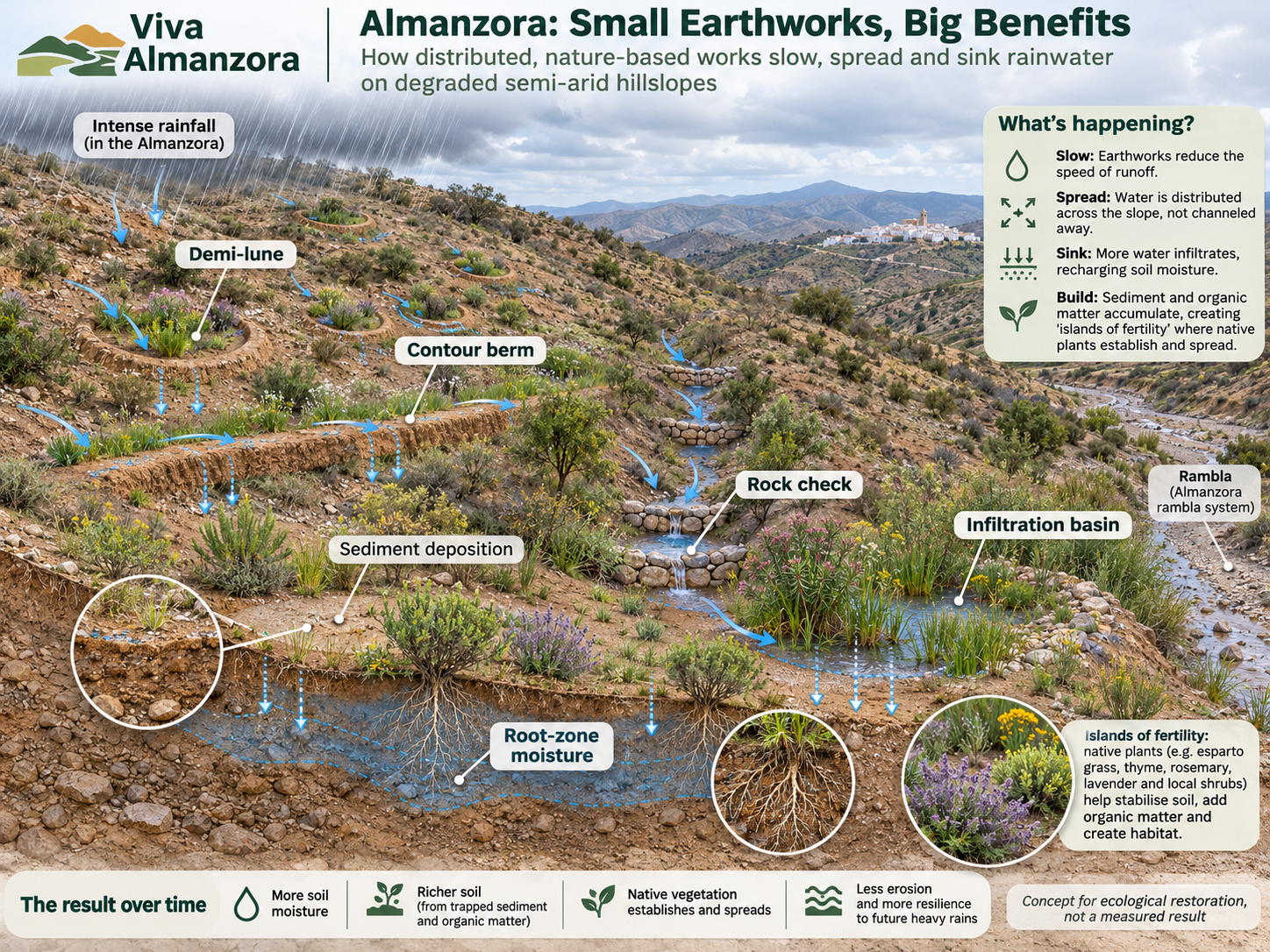
For the sake of my argument that many smaller earthworks are better than a single large one - here the time constraint is key. After spending time observing and measuring, you can make a demi-lune on a gradual slope where you want to catch surface runoff – in as little as a few hours if you take a pickaxe and shovel. Planning and implementation in 1 day, ready to receive the next downpour and allow the re-iterative process to continue. If there are amendments to be made to optimise it, you can remedy them in another 1-day expenditure, this can be repeated many times and the modularity of the independent demi-lunes means the ones that worked, are left as they are. The builder can focus on the ones that didn’t.
In comparison, if you made a berm and swale on the same slope covering for example 100 Meters, ideally, you’d have spent a lot more time measuring the contours, marking them out, planning logistics of getting a skid steer or excavator hired in, having a competent person to operate it – this in itself is already something taking you past the 1 or 2 day mark.
From the outset, doing a larger construction as opposed to lots of smaller ones offers the advantage that an earthmoving vehicle can move between 11-18 times as much earth as a single person compared, side by side over a given period. Providing access for the equipment, and egress once the earthwork is finished (to minimise compaction and damage to surrounding land) takes time Aswell. These factors introduce several smaller interdependencies which can all add time to a schedule. Add in the fact that once the rain comes, if you scheduled it correctly and all is finished beforehand, you have 1 chance to get it right. If for whatever reason the earthworks doesn’t perform as expected, you now have a drying out period to wait for before you can get back in with machinery to fix it, you are dependent on the operator’s availability etc. This all adds time that you may or may not have to maximise the returns on your initial investment. The window of opportunity may therefore be smaller due to the mounting number of constraints meaning iteration to getting the earthworks working as intended can end up taking far longer than it seemed at the start. In terms of time then and their inherent capability of being amended quickly – smaller distributed earthworks provide far less risk for your efforts.
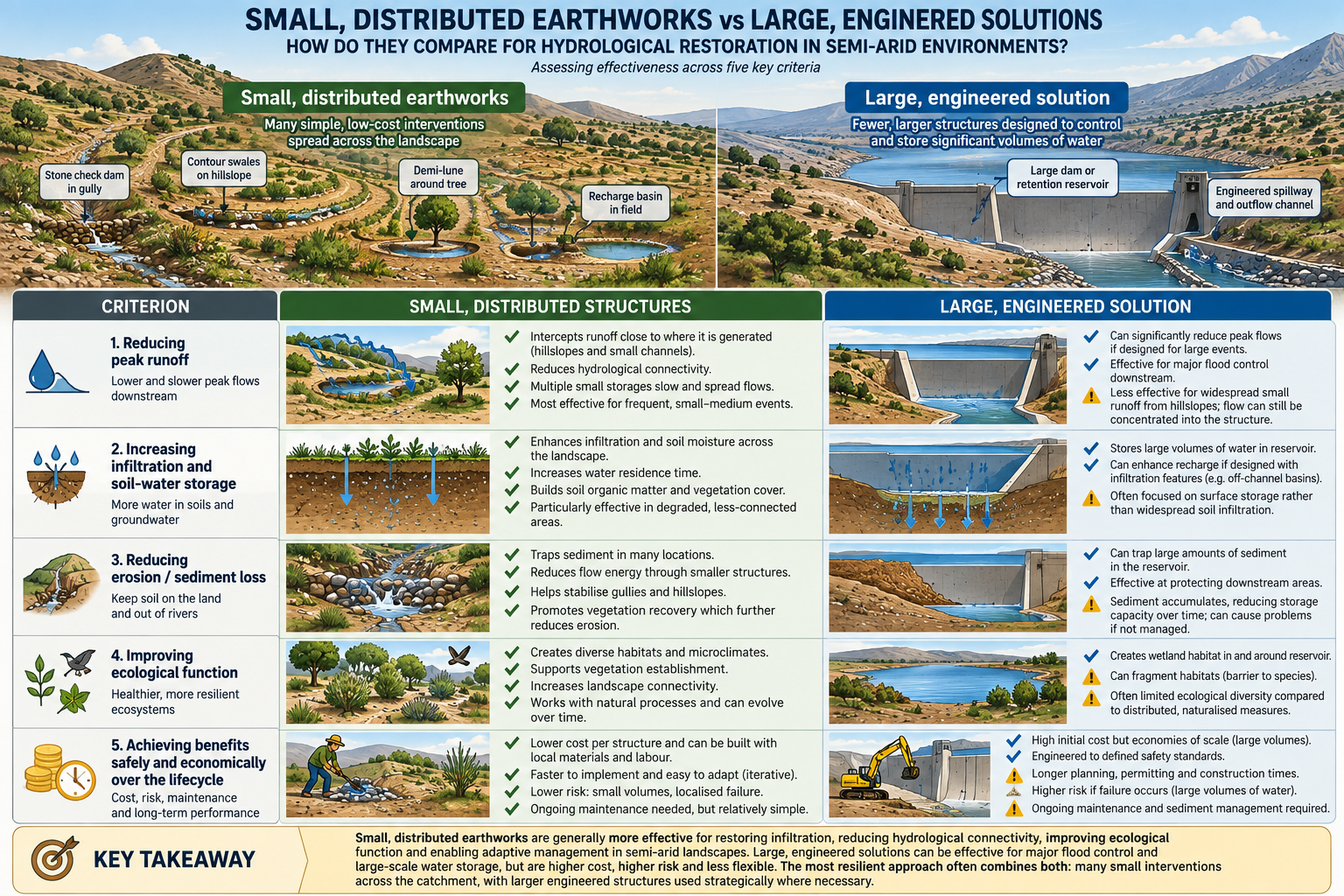
Complexity
When comparing the 2 approaches from the angle of complexity, although a batch of small distributed check dams placed in ravines and ephemeral waterways are simple in their design and function alone, the number of them working together to form a system of interventions naturally creates a level of complexity itself. One small check dam on its own is simple, 10 in a row becomes a cascading waterway with each installation now detaining water for limited periods of time, accumulating silt and building natural soil terraces, requiring maintenance and all being subject to the possibility of failure. If these are distributed enough then compared to a larger dam which holds an equivalent volume of water, the effort required to build and maintain them could actually end up greater for the smaller distributed earthworks method. (Its worth noting that silt and soil buildup is the intention and that they are in a way designed to eventually fail, the rework is expected if they succeed.)
Complexity of the design for larger structures obviously takes over once you need to start involving engineers and gaining approval from authorities to implement it safely, but on the plus side in favour of the larger structure- there is only 1 to monitor, and 1 location to occasionally visit to maintain.
Each country, region or county have their own laws and standards that must be adhered to. It is quite common the world over to have requirements imposed on any efforts to dam and store water over a certain threshold, also there can be restrictions on how much you can alter a watercourse – to prevent depriving those downstream of the water they receive from above in the catchment.
These can even differ from one valley to the next, for example Within the Almanzora basin, works affecting public watercourses and their associated protection zones are regulated under Spanish national water legislation and the Andalusian Mediterranean Basin Hydrological Plan. The primary water authority is the Junta de Andalucía, through its water administration for the Demarcación Hidrográfica de las Cuencas Mediterráneas Andaluzas.
The Almanzora basin is expressly included within this river basin district. This matters because it is different from the neighbouring Segura basin, administered by the Confederación Hidrográfica del Segura (CHS).
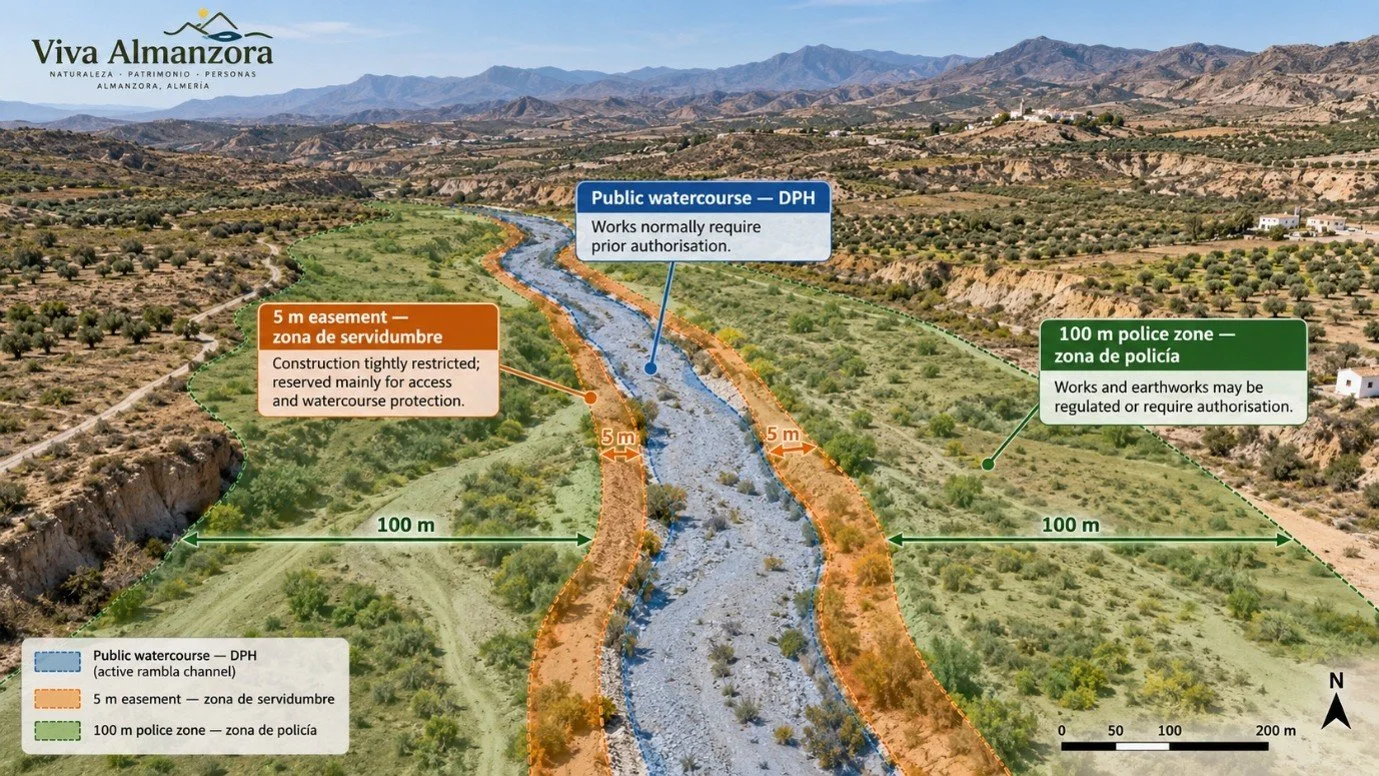
In this particular case then, that makes it not as clear cut as it looks from the outset. Although simpler in design, having multiple permissions and consents for many structures could become more complexed especially from an administrative point of view. And would take some additional effort to get the green light for installation that could either equalize or tip the scales the other way when deciding which type of intervention is better when viewed from a complexity lens.
Size – how big is the plot of land you are aiming to utilize/optimise? how many different stakeholders are involved with your project?
When comparing the two options for restorative interventions in each parcel of land, size is a major factor to deal with in their design and installation. The bigger the plot, the more potential rainfall there is to capture, the more likelihood of water ingressing from a neighbouring property and there may be established waterways running off the land you hold which other landholders have rights to.
If the parcel is smaller then you find yourself limited to what’s practical in the room, you have and the use of the water. Smaller plots are far better suited to many smaller structures. Bigger chunks of an area can potentially store much larger amounts of water, but this goes hand in hand with more responsibility and risk of catastrophic failure, as well as the consequences downstream.
As covered above in the complexity section, bigger means more red tape and involvement by third parties to get approval, inspect the structures during and after construction. They also require more specialised skillsets to build, monitor and maintain.
Cost – how much money can you afford to spend, what is the appetite for incurring costs and are there efficiencies of scale to be capitalised on?
For situations where time is a major constraint for whatever reason, the availability of time can be the deciding factor on what decisions are made. Considering it from a hydrological perspective relevant to today, you could frame it as: “We have a 15 Hectare site in the Almanzora Valley. Wildfire season is approaching; we have 9 months to prepare for it”. In this situation the design and build of the measures to be put in place would have to factor in surveys, desktop and site-based designs, applications to governing bodies in the area, approval times, then procurement of contracts, plant, labour etc, delivery of materials and how you would finish the project after.
By opting for smaller decentralised earthworks, you could first categorize and prioritize the areas that provide the best ROI, beginning with surveys and observations, creating a model of the plot of land, identifying geological and topographical features, and quickly designing & marking out contours. From there you could reasonably quickly begin building 1-rock dams, clearing out brush and litter etc whilst organizing bigger work events. By opting to do the smaller works, the entire task can be broken down into smaller tasks. The procurement time on 4 shovels and a skip, markers and fencing materials is usually non-existent, and can be bought off the shelf. There aren’t always permits required so potentially no waiting times there, and the tasks can be made small enough to fit in around volunteer’s busy schedules meaning time saved waiting for a contractor to become free to do the work.
With regards to the building and maintenance, smaller distributed structures have the advantage of having a lower barrier to entry when considering required competence of the builders, these types of projects are typically carried out by volunteers and students for little to no money at all. A far cry from contractors, with plant and machinery, and the required enabling work to carry out the actual installation. Time is money and with these additional pieces of the puzzle there is an optimal sequence of construction that needs to be planned out in advance with many interconnected moving parts, should any of them fail then there are contractual (usually costly) implications. Providing they can be considered as effective in our sites circumstances then this seems like a viable option. Considering the findings from Castillo et al. (2007), Check-Dam performance, sediment accumulation and downstream erosion all showed positive changes in the catchment the treatment was applied to.
Depending on how big the project is, there is an inevitable factor of ‘organisational friction’ which adds delay and confusion into the mix. This stems from communication issues, personalities of people involved, commercial motivations and bureaucracy.
Finally, when considering cost, the cost of failure in both types is worth consideration, depending on how much is spent at the start then on the maintenance for the Lifecycle of the structure the cost of failure could be argued either way without going into tailored scenarios. A hectare of land treated with each method could fail whether its 1 large body of water suddenly moving downhill due to a single catastrophic failure, or a series of cascading failures – would ultimately end up flooding a similar amount from the perspective of those downstream.
In conclusion:
The angle I approach this problem from on a site basis with its tailored local design, is also how I view the wider project from a ‘bird’s eye view’. Distributed earthworks is my preferred option, I propose taking the easiest, lowest barrier to entry - method of optimising land primarily for rainwater capture & infiltration. I say primarily because the benefits of flood attenuation and wildfire impact mitigations are bonuses you may or may not experience as a consequence of water sequestration.
Zoomed out, distributed parcels of carefully chosen land within a catchment would again potentially return better return on investment, the more scraps of land used to slow down heavy downpours, minimising erosion by damping that hortonian runoff curve – the better it works overall and adds to the success the next year. As mentioned earlier on, it’s the strategic placement of structures at convergence points that can make or break the success conditions on each structure.
The convenience and modularity of for example 10 farmers & landowners installing several small earthworks on their own sites, which they have lived on and observed over years, - means they can work at their own pace, observe and make changes as they go.
Everyone’s effort and mental capacity is manageable and not too intimidating to start. Results can be seen within months and build from there. Distributed means more likelihood of capturing more flood events wherever they occur. The same amount of land in one place means you most likely need more money, people, permissions and for the rain to hit that spot to get the same results. A longer period between means less opportunity to make improvements as the structures are put through their paces, and smaller failures or repairs may take longer & more money to fix.